How thick should the coating be? sounds like it should have a simple answer. It doesn’t. A polyurea system specified at the right thickness for a truck bed liner would be wildly undersized for a secondary containment lining, and a thickness that makes sense for a bridge deck membrane would be needlessly heavy and expensive for a light-duty interior floor. Thickness isn’t a universal number, it’s a variable that has to match the specific demands of the application.
This guide breaks down what a mil actually measures, why thickness requirements swing so widely across applications, and how to avoid the two most common mistakes: under-specifying a system that needs to perform under real stress, and over-specifying one where the extra material adds cost without adding meaningful protection.
Understanding the Basics: What a Mil Actually Measures
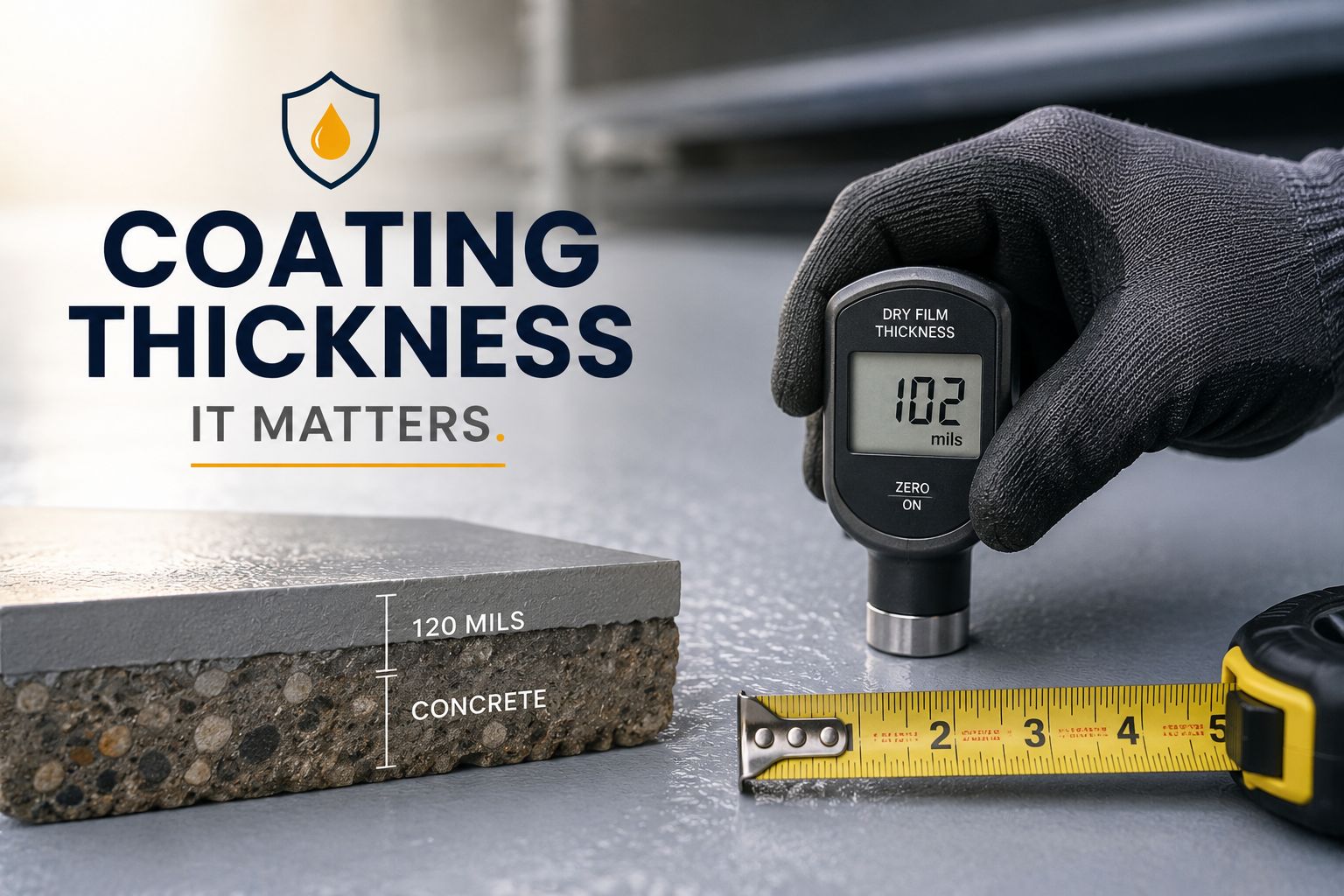
A mil is one-thousandth of an inch, the standard unit used across the coatings industry for measuring both wet film thickness during application and dry film thickness once cured. For context, a typical sheet of copy paper runs around 3 to 4 mils thick, which helps put some of the thickness ranges discussed below into perspective, since a coating spec calling for 80 mils is roughly the thickness of twenty sheets of paper stacked together.
Thickness gets measured two ways during a project. Wet film thickness is checked during application with a simple gauge, giving the crew real-time feedback on whether they’re building material at the right rate. Dry film thickness is measured after cure, typically with a magnetic or ultrasonic gauge depending on the substrate, confirming the finished coating actually meets the specified thickness once shrinkage and cure are accounted for.
Why Thickness Requirements Vary So Much
Several factors drive the thickness a given application actually needs, and none of them are arbitrary.
Mechanical stress. A surface facing constant abrasion, impact, or heavy traffic needs enough material thickness to absorb that stress over time without wearing through to the substrate. A light-duty interior surface with minimal foot traffic simply doesn’t face the same wear profile.
Chemical exposure. Thicker coatings generally provide a longer service life against chemical attack, since there’s more material to gradually degrade before the substrate itself becomes exposed. Applications with aggressive or frequent chemical exposure typically call for thicker specifications than those with occasional, mild exposure.
Waterproofing and membrane performance. Where a polyurea system is functioning as a waterproofing membrane rather than a wear surface, thickness relates directly to the material’s ability to bridge minor substrate cracks and maintain a continuous, impermeable barrier under structural movement.
Structural or blast performance. Applications where the coating needs to absorb significant energy, whether from seismic movement, impact, or blast forces, require enough material thickness to actually provide meaningful elongation and energy absorption rather than a thin veneer that would simply tear.
Cost and practicality. More material costs more, in both product and labor. Specifying more thickness than an application genuinely needs isn’t a safety margin so much as an unnecessary expense, and a good specification finds the point that meets real performance requirements without padding it further.
Typical Thickness Ranges by Application Category
These ranges reflect general industry practice and published application guidance, not any single manufacturer’s proprietary specification. Always confirm exact requirements against the specific product’s technical data sheet and any project-specific engineering requirements before finalizing a spec.
Truck bedliners and light vehicle protection typically run in a moderate thickness range suited to impact and abrasion resistance without adding unnecessary weight or cost to a relatively low-stress application compared to industrial settings.
Interior industrial flooring generally uses a lighter build for foot traffic and light equipment areas, stepping up meaningfully for forklift traffic, heavy equipment zones, or areas with frequent chemical exposure.
Secondary containment linings tend to specify a thicker build than typical flooring, reflecting the higher consequence of any breach and the chemical exposure these systems are specifically designed to withstand over an extended service life.
Roofing membranes usually fall in a range calibrated to balance waterproofing performance, UV-topcoat compatibility, and practical material cost across a large surface area.
Bridge deck and infrastructure waterproofing membranes call for a notably heavier build, commonly in the 80 to 160 mil range according to widely referenced infrastructure application guidance, reflecting the combination of chloride exposure, thermal cycling, and traffic loading these membranes have to withstand for the life of the structure. Our applications and use cases guide covers this and several other application-specific thickness contexts in more detail.
Blast-resistant and structural retrofit applications generally require the heaviest builds of any common application category, since the coating’s ability to absorb energy and resist fragmentation depends directly on having enough material thickness to elongate meaningfully under sudden load.
The Risk of Getting Thickness Wrong in Either Direction
Under-specifying thickness is the more commonly discussed risk, and for good reason. A coating applied too thin for its application wears through faster than expected, exposing the substrate to the exact damage the coating was meant to prevent, and often failing well before the project’s expected service life. This is a particularly costly mistake in high-consequence applications like secondary containment or infrastructure waterproofing, where failure isn’t just an aesthetic problem.
Over-specifying thickness is less discussed but still a real cost issue. Material and labor costs scale with thickness, and specifying well beyond what an application actually requires doesn’t necessarily add proportional value, particularly for lower-stress interior applications where a lighter, correctly matched system would perform just as well at meaningfully lower cost.
The right approach isn’t defaulting to “thicker is always safer.” It’s matching thickness to the specific stress profile, chemical exposure, and performance expectations of the actual application.
How Thickness Interacts With Application Method
Achieving a specified thickness isn’t just about product selection, it’s about application technique. Polyurea’s rapid cure means material has to be built up in controlled passes, since the fast reaction time doesn’t allow for the kind of slow, self-leveling build some other coating chemistries rely on. An experienced applicator monitors wet film thickness continuously during the spray process rather than applying material and hoping the final thickness lands where it needs to.
For applications requiring a particularly heavy build, like bridge deck membranes or blast-resistant systems, multiple passes are typically required to reach the specified thickness without introducing defects that can occur when too much material is applied in a single pass. This is one of several reasons why thickness specification and application technique need to be planned together rather than treated as separate concerns. Our complete guide to polyurea coating covers the broader technical fundamentals that inform both the specification and the application process.
Thickness Reference by Application Type
| Application Category | Relative Thickness Demand | Primary Driver |
|---|---|---|
| Light interior flooring | Lower | Foot traffic, light-duty use |
| Truck bedliners | Moderate | Impact and abrasion resistance |
| Heavy industrial flooring | Moderate to higher | Forklift traffic, chemical exposure |
| Roofing membranes | Moderate | Waterproofing performance, UV topcoat compatibility |
| Secondary containment | Higher | Chemical exposure, breach consequence |
| Bridge deck/infrastructure membranes | High (commonly 80-160 mils) | Chloride exposure, thermal cycling, traffic load |
| Blast-resistant/structural retrofit | Highest | Energy absorption, elongation under sudden load |
Things to Consider When Specifying Thickness
- What’s the actual mechanical stress profile of the application, foot traffic, vehicle traffic, or something more extreme?
- What chemical exposure will the coating realistically face, and how frequently?
- Is the coating functioning as a wear surface, a waterproofing membrane, or a structural/energy-absorbing system, since each has a different thickness logic?
- Has the specific product’s technical data sheet been checked for its recommended thickness range for this application category?
- Is there a plan for verifying both wet film thickness during application and dry film thickness after cure, rather than assuming the spec was met?
For applications specifically involving concrete floors, our guide on industrial concrete floor coatings goes deeper into how substrate prep and system selection interact with thickness decisions for that particular category.
Verifying Thickness After Application
Specifying the right thickness only matters if the finished coating actually achieves it. Dry film thickness testing after cure, using a gauge appropriate to the substrate, confirms whether the specified build was actually achieved or whether thin spots exist that could compromise performance in specific areas. This is a step that’s easy to skip on smaller projects but becomes increasingly important as project size and consequence of failure increase.
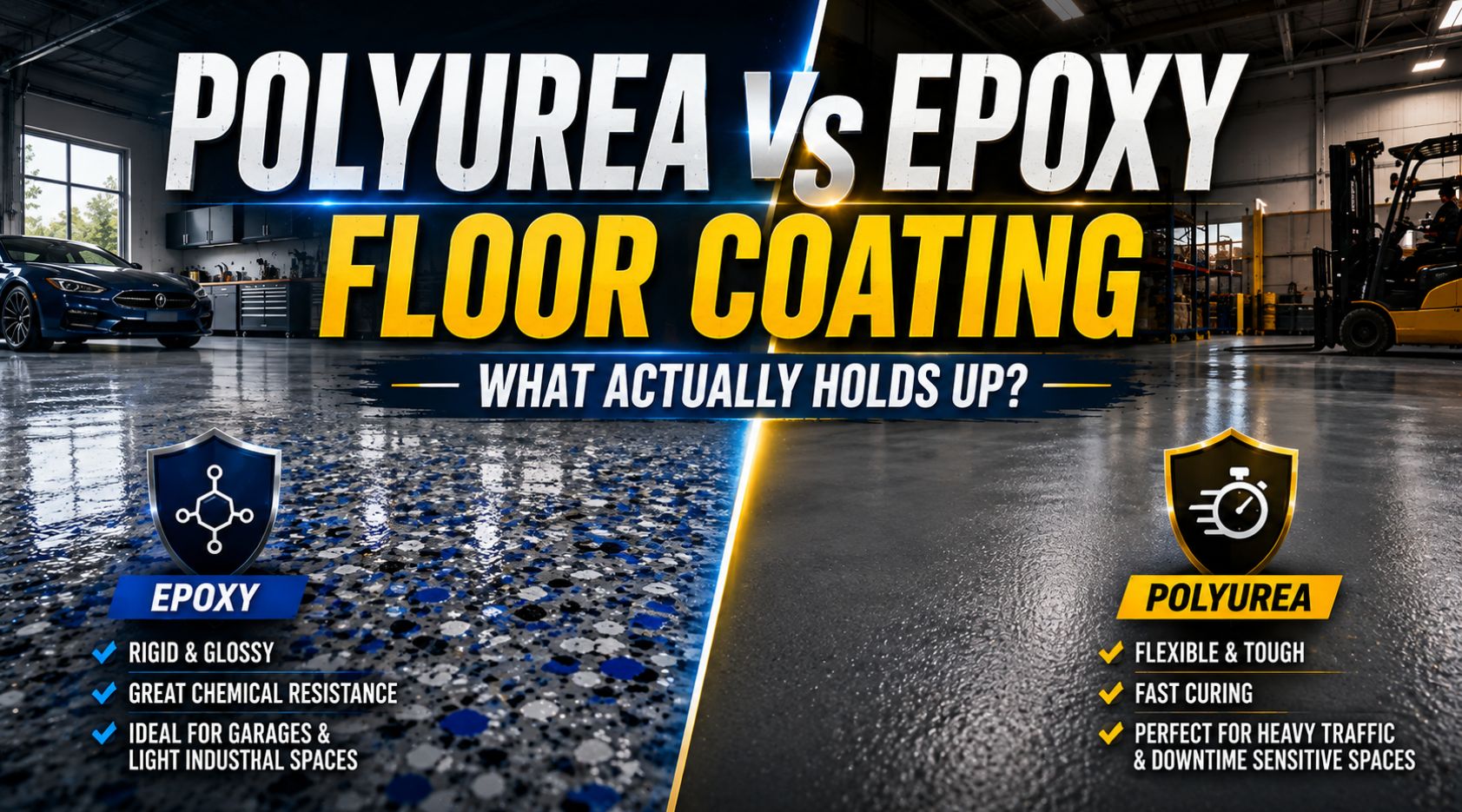
Documentation of thickness verification also matters for the same reasons documentation matters elsewhere in coatings work: it creates a record that protects both the applicator and the client if a performance question comes up later in the coating’s service life. For a broader look at how coating choice and performance questions get evaluated, our comparison of polyurea versus epoxy floor coating covers how these decisions play out for one of the most common application categories.
Frequently Asked Questions
What’s a typical thickness range for a garage floor coating?
Light residential and light commercial floor applications generally use a thinner build than heavy industrial settings, since foot traffic and occasional vehicle use create far less mechanical stress than forklift traffic or heavy equipment areas.
Why do bridge deck coatings need to be so much thicker than floor coatings?
Bridge decks face a combination of chloride exposure from deicing salts, thermal cycling, and heavy traffic loading over the structure’s full service life, a stress profile that calls for significantly more material thickness than an interior floor would ever need.
Can a coating be too thick?
Yes, in the sense that thickness beyond what an application requires adds cost without proportional benefit, and in some cases can introduce application challenges like extended cure time or increased risk of defects during a rushed heavy build.
How is coating thickness actually measured?
Wet film thickness is checked during application with a gauge for real-time feedback, and dry film thickness is measured after cure using a gauge appropriate to the substrate, confirming the finished coating meets the specified build.
Where can I find the exact thickness spec for a specific product and application?
The manufacturer’s technical data sheet for that specific product is the authoritative source, since thickness recommendations vary by formulation even within the same general application category.
Conclusion
Coating thickness isn’t a single number to memorize, it’s a variable that has to be matched to what a specific application actually demands: the mechanical stress it faces, the chemical exposure it sees, and the performance role the coating is playing, whether that’s a wear surface, a waterproofing membrane, or an energy-absorbing structural system. Getting thickness right, and verifying it was actually achieved once the project is complete, is what separates a coating system that performs as expected for its full service life from one that either fails early or cost more than it needed to.
Get polyurea news in your inbox
New articles, application guides and industry news from American Polyurea. Unsubscribe anytime.