
Polyurea’s unique combination of physical properties — rapid cure, exceptional tensile strength, flexibility, chemical resistance, and abrasion resistance — makes it one of the most versatile coating and lining materials in the protective coatings industry. Understanding where and how polyurea is applied helps specifiers and applicators identify the right situations for this technology and communicate its value to clients.
50+
Distinct Application Categories
$8.4B
Global Market by 2028
12%+
Annual Market Growth Rate
Infrastructure & Civil Engineering
Infrastructure applications represent the fastest-growing segment of the polyurea market, driven by aging public works assets and the superior life-cycle economics of polyurea rehabilitation versus concrete replacement. Key infrastructure applications include:
Bridge Deck Waterproofing
Bridge decks face an aggressive combination of chloride exposure from deicing salts, thermal cycling, and traffic loading. Polyurea waterproofing membranes applied to bridge decks protect the reinforced concrete slab from moisture and chloride intrusion, dramatically extending service life. Specifications typically call for 80-160 mils applied over a properly prepared and primed concrete surface, with a wearing course applied over the membrane. Read our detailed guide: The Role of Polyurea in Bridge and Infrastructure Preservation.
Wastewater Treatment Facilities
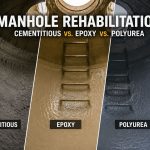
Wastewater treatment structures — clarifiers, digesters, equalization basins, manholes, and lift stations — are continuously degraded by microbiologically influenced corrosion (MIC). Polyurea provides an impermeable, chemically resistant barrier that stops this deterioration. Learn more in our comprehensive guide: Polyurea for Wastewater Treatment Facilities.
Stormwater Infrastructure
Concrete drainage channels, detention basins, culverts, and stormwater vaults require protection from erosion, abrasion, and chemical attack from urban runoff. Polyurea has become the preferred rehabilitation coating for municipal stormwater infrastructure managers seeking long-term asset protection at manageable cost.
Pipeline Corrosion Protection
Polyurea is widely used as a field-applied joint coating for buried pipelines, providing continuity of corrosion protection at weld joints and repair areas. It is also used as a primary coating for above-ground pipelines and as a lining for internal pipe rehabilitation. Read more: How Polyurea Pipeline Coatings Changed Pipeline Protection.
Industrial & Commercial
Secondary Containment
EPA regulations require secondary containment systems for chemical and fuel storage areas to prevent environmental contamination from spills. Polyurea coatings create seamless, chemical-resistant containment linings that meet regulatory requirements while withstanding the physical demands of industrial environments. Read our detailed article: Polyurea for Secondary Containment.
Industrial Flooring
Industrial floors subjected to forklift traffic, chemical exposure, and heavy machinery require coating systems that can withstand both mechanical and chemical attack simultaneously. Polyurea and polyurea/polyurethane hybrid floor coatings provide outstanding durability in these environments, with the additional advantages of rapid cure (typically 24-hour return to service) and seamless, easy-to-clean surfaces.
Mining Applications
Mining ore transfer chutes, hoppers, haul truck beds, and processing equipment are subjected to extreme abrasion. Mining-grade polyurea formulations provide abrasion resistance that rivals or exceeds rubber liners, with the practical advantages of spray application, faster installation, and seamless coverage. Read our in-depth guide: Polyurea Coatings in the Mining Industry.
Roof Coatings and Waterproofing
Polyurea and polyurea/polyurethane hybrid systems are used as seamless roofing membranes, either applied directly to prepared substrates or sprayed over rigid polyurethane foam insulation for a combined insulation and waterproofing system. Rapid cure and seamless application make polyurea particularly valuable for projects where installation time or building occupancy is a constraint. Read more: Polyurea Roof Coatings: Performance and Cost Considerations.
Specialty & Emerging Applications
Seismic Retrofit
Research from leading universities has demonstrated that polyurea-coated masonry and concrete structures show significantly improved performance under seismic loading — resisting fragmentation and maintaining structural integrity. West Coast applicators are increasingly working with structural engineers to incorporate polyurea into seismic upgrade programs for unreinforced masonry buildings.
Safe Room and Blast-Resistant Construction
Polyurea’s high elongation and tensile strength allow it to absorb blast energy and prevent structural fragmentation. It is used as a coating on the interior surfaces of safe rooms, shelters, and blast-resistant structures in both residential and military applications. Read our detailed guide: Using Polyurea for Safe Room Construction.
Shooting Range Coatings
Polyurea coatings applied to shooting range backstops and bullet traps provide lead containment, ricochet prevention, and simplified cleanup of lead contamination. Purpose-formulated polyurea systems specifically designed for shooting range applications are available from several manufacturers. Read more: Making Shooting Ranges Safer with Polyurea.
Cistern Liners
Water storage cisterns — both above-ground and below-ground — require food-safe (for potable water) or chemical-resistant (for industrial water storage) lining systems. NSF 61-certified polyurea formulations are available for potable water contact service. Read our analysis: How Polyurea Liners are Redefining Cistern Economics.
Dunnage and Cargo Protection
Polyurea-coated dunnage provides impact-resistant, cleanable surfaces for cargo staging and transport operations. Marine and intermodal shipping environments are particularly interested in polyurea dunnage for its combination of durability and resistance to moisture, fuel, and other shipboard contaminants. Read more: The Role of Dunnage Coatings in Cargo Protection.
Choosing the Right Polyurea System for Your Application
With dozens of polyurea formulations available and application parameters that vary significantly by project, selecting the right system requires technical knowledge and sometimes manufacturer guidance. Our comprehensive guide — How to Choose the Right Polyurea System — walks through the key decision factors. You can also consult with our community of experienced applicators and find qualified contractors through our Find a Certified Applicator directory.
For a deeper dive into polyurea technology fundamentals, visit our Polyurea FAQ and Industry Glossary. The Industry Resources & Standards page provides links to the technical standards that govern polyurea applications in various industries.