
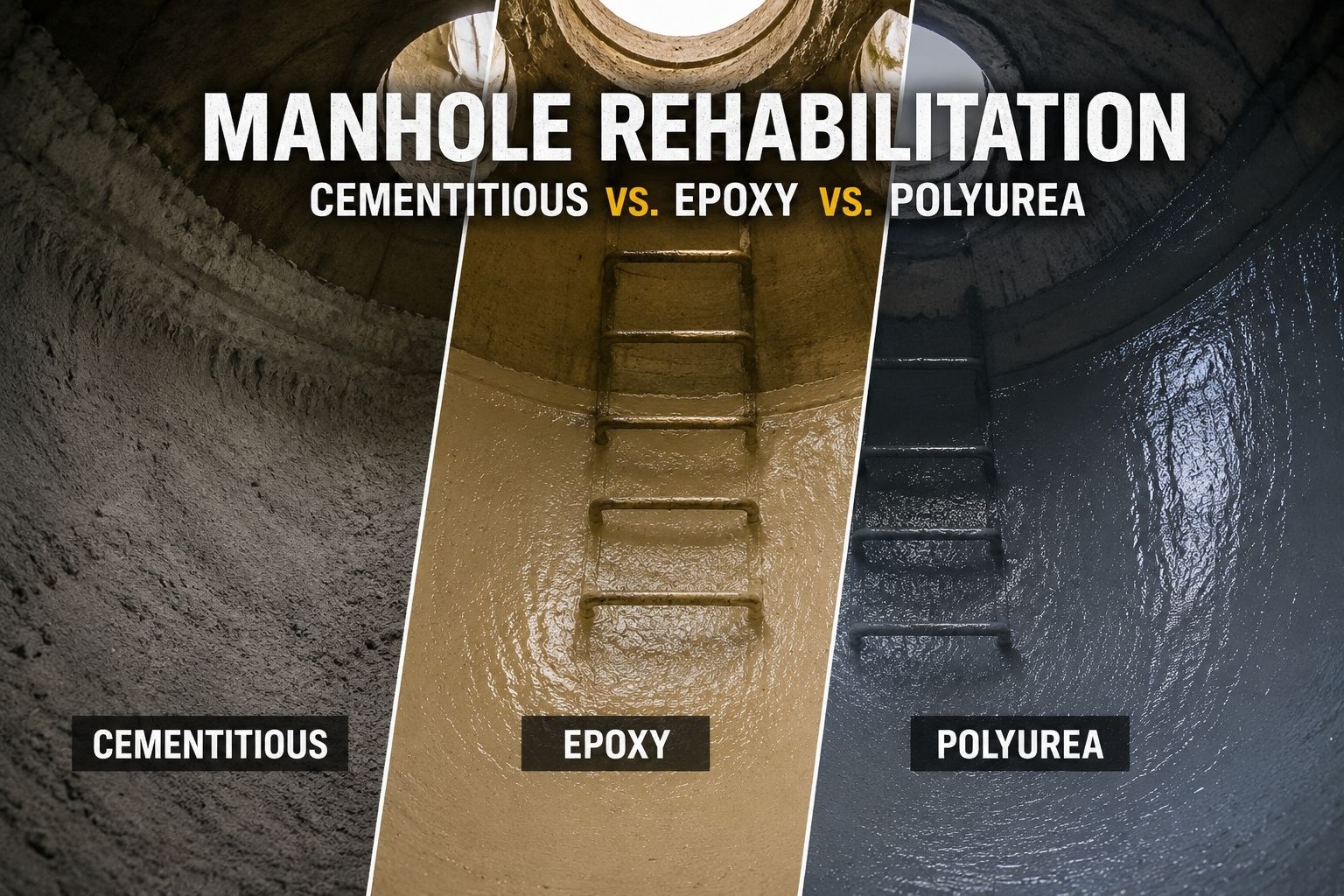
There’s a specific kind of damage that happens inside a sewer manhole that most people never think about, mostly because they’d rather not. Hydrogen sulfide gas, generated by the bacteria living in wastewater, converts to sulfuric acid on exposed surfaces, and that acid eats through concrete in a way that’s genuinely aggressive. A manhole that looked structurally fine a decade ago can be crumbling at the crown today, and the municipality footing the bill is left choosing between three main rehabilitation approaches: cementitious lining, epoxy lining, or polyurea lining. Each one solves the problem differently, and picking the wrong one for a given manhole’s actual condition tends to show up again a lot sooner than anyone budgeted for.
This piece walks through what actually separates these three methods, not just on paper, but in terms of what holds up once it’s back underground dealing with the same corrosive environment that caused the original damage.
Why Manholes Fail in the First Place
Before getting into the rehabilitation methods themselves, it’s worth being clear about what’s actually being repaired, because the failure mechanism drives almost every decision that follows. Biogenic corrosion, the process where hydrogen sulfide gas converts to sulfuric acid on exposed concrete surfaces, is the dominant cause of manhole deterioration in most sewer systems, particularly in warmer climates and low-flow areas where gas concentration tends to build up. This corrosion attacks the concrete itself, softening and eating away at the surface, weakening the structure from the inside out even when the exterior still looks intact.
Infiltration and exfiltration add a second layer of trouble. Cracks and joint failures let groundwater in or wastewater out, both of which are problems regulators care about for very different reasons, and both of which tend to get worse over time rather than staying static. A manhole with active infiltration is usually also a manhole with structural cracking that needs to be addressed as part of any rehabilitation, not just coated over.
Cementitious Lining
Cementitious lining involves spraying or troweling a cement-based mortar onto the interior surface, essentially rebuilding lost material and creating a new protective layer. It’s been used for decades, it’s relatively affordable, and for a manhole with moderate deterioration and low ongoing corrosion risk, it can be a perfectly reasonable choice.
The catch is that cementitious materials, even specially formulated ones, are still fundamentally cement-based, which means they remain vulnerable to the same biogenic corrosion process that damaged the original structure. In a manhole with active, ongoing hydrogen sulfide exposure, a cementitious liner can start showing the same deterioration pattern within a handful of years, which turns what looked like a cost-effective fix into a repeat expense down the line. This method tends to work best where corrosion risk is genuinely low, or as a structural rebuild step underneath a more corrosion-resistant topcoat rather than as the final protective layer on its own.
Epoxy Lining
Epoxy lining offers a meaningful step up in chemical resistance compared to cementitious systems, since the epoxy itself isn’t vulnerable to acid attack the way cement is. It’s applied as a coating over the prepared substrate, sometimes combined with a structural cementitious rebuild underneath if the manhole has lost significant wall thickness.
Epoxy systems generally need more careful surface preparation and cure time than some alternatives, and cure conditions matter, moisture and temperature during application affect how well the epoxy bonds and cures. Get those conditions wrong and adhesion problems can develop that aren’t always obvious until the liner starts failing at the bond line. Epoxy sits in a reasonable middle ground on cost and performance, better corrosion resistance than plain cementitious, but not always matching the flexibility and speed that polyurea systems offer.
Polyurea Lining
Polyurea has become an increasingly common choice for manhole rehabilitation specifically because it addresses the weaknesses of the other two options directly. It’s highly resistant to the sulfuric acid produced by biogenic corrosion, which is the actual failure mode most manholes are dealing with in the first place. It cures extremely fast, often within minutes, which matters a lot when a crew is working in a confined space and wants to minimize the time a manhole is out of service or a crew is exposed to a below-grade environment. And it’s flexible enough to handle the minor structural movement that concrete infrastructure experiences over time without cracking the way a more rigid lining might.
The tradeoff is cost. Polyurea systems typically carry a higher material and application cost than cementitious or standard epoxy options, and that upfront cost is the main reason municipalities sometimes default to cheaper alternatives even in manholes where the corrosion severity would justify the more resistant system. Our complete guide to polyurea coating covers the underlying chemistry that gives polyurea this corrosion and flexibility advantage, which is worth understanding before comparing it purely on price against the other two methods.
What Actually Drives the Right Choice
The severity of the manhole’s corrosion exposure is really the first thing worth establishing, before cost enters the conversation at all. A manhole in a low-flow, low-hydrogen-sulfide area doesn’t need the same protection as one sitting in a system known for aggressive biogenic corrosion, and spending polyurea-level money on a manhole that was never at serious corrosion risk is money that could have gone toward a manhole that actually needed it.
Structural condition matters just as much. A manhole that’s lost significant wall thickness needs a structural rebuild, typically cementitious, before any protective lining goes on, regardless of which lining material ultimately gets chosen. Skipping that step and coating over a structurally compromised wall doesn’t solve the underlying problem, it just hides it temporarily.
Downtime and access constraints often get less attention than they deserve in this decision. A manhole in a busy intersection or a high-traffic area benefits disproportionately from a fast-curing system like polyurea, since minimizing the time a crew needs the site closed off has real value beyond just the material performance question. A manhole in a low-traffic area with easier access has more flexibility to use a slower-curing, lower-cost system without that access disruption being as costly.
Comparing the Three Methods
| Factor | Cementitious | Epoxy | Polyurea |
|---|---|---|---|
| Corrosion resistance | Lower, still cement-based and vulnerable to acid attack | Moderate to good | High, strong resistance to sulfuric acid exposure |
| Cure time | Slower | Moderate, sensitive to conditions | Very fast, often minutes |
| Flexibility | Low, rigid | Low to moderate | High |
| Cost | Lowest | Moderate | Highest |
| Best for | Low corrosion risk, structural rebuild layer | Moderate corrosion, budget-conscious projects | High corrosion risk, high-traffic or access-constrained sites |
| Typical role | Structural repair, sometimes under a topcoat | Standalone protective lining | Standalone lining where corrosion resistance and speed both matter |
The Installation Process Isn’t Identical Across Methods
Surface preparation matters for all three, but the specifics differ. Cementitious application generally needs a sound, clean substrate that the new mortar can bond to structurally, sometimes requiring removal of deteriorated material down to sound concrete first. Epoxy needs careful moisture control during application, since epoxy adhesion is particularly sensitive to substrate moisture content. Polyurea’s fast cure means the application window for proper surface contact and bonding is short, which puts more emphasis on getting substrate prep and application technique right the first time, since there’s less room to correct an application mistake mid-process the way there might be with a slower-curing system.
For municipalities weighing rehabilitation against a full manhole replacement in more severe cases, the same coat-versus-replace logic that applies to other infrastructure decisions is worth considering here too. Our piece on coating versus replacing an aging commercial flat roof covers a similar decision framework, structural soundness first, cost and disruption second, that applies conceptually to manhole rehabilitation even though the specific infrastructure is completely different.
Things to Consider Before Choosing a Method
- What’s the documented corrosion history and hydrogen sulfide exposure level for this specific manhole, rather than a general assumption based on the system as a whole?
- Has structural condition been assessed thoroughly enough to know whether a rebuild layer is needed before any protective lining goes on?
- How much does minimizing site downtime and traffic disruption actually matter for this particular location?
- Is the budget being allocated based on which manholes actually need the highest level of protection, or spread evenly regardless of individual risk?
- Has the contractor’s experience with the specific lining method been verified, since installation quality affects performance as much as material selection does?
Cost comparisons across rehabilitation methods follow similar logic to other coating decisions, where the cheapest option upfront isn’t always the cheapest option over the full service life. Our guide on what drives coating cost per square foot breaks down the factors that apply to polyurea pricing specifically, many of which carry over directly to manhole lining project budgets.
Maintenance After Rehabilitation
Even a properly lined manhole benefits from periodic inspection, since access points, joints, and transition areas between the lining and the original structure are the spots most likely to show early signs of trouble if something wasn’t installed quite right. Municipalities managing a large inventory of rehabilitated manholes tend to get more value out of a scheduled inspection program than a purely reactive one, catching a small issue during a routine check rather than after a failure that requires emergency repair. Our overview of polyurea applications touches on how this kind of proactive maintenance mindset applies across the range of infrastructure where polyurea gets used, not just manholes specifically.
Frequently Asked Questions
Why do some manholes corrode faster than others in the same sewer system?
Hydrogen sulfide gas concentration varies by flow conditions, temperature, and location within the system, so low-flow areas or spots where gas can accumulate tend to see more aggressive biogenic corrosion than high-flow, well-ventilated sections.
Is cementitious lining ever the right choice?
Yes, particularly for manholes with low corrosion risk or as a structural rebuild step underneath a more corrosion-resistant topcoat, rather than as the sole protective layer in a high-corrosion environment.
Why does polyurea cost more than the other two methods?
Its material formulation and application process, along with the corrosion resistance and cure speed it delivers, generally carry a higher cost than cementitious or standard epoxy systems, though that cost needs to be weighed against reduced downtime and longer service life in high-corrosion applications.
Can these methods be combined?
Yes, this is fairly common. A structurally compromised manhole might get a cementitious rebuild layer first, followed by an epoxy or polyurea topcoat for corrosion protection, rather than relying on a single material to handle both the structural and protective roles.
How long does a manhole rehabilitation project typically take?
It depends heavily on the method and the manhole’s condition, but polyurea’s fast cure time generally allows for a quicker return to service compared to cementitious or epoxy systems that need longer cure periods before the manhole can go back into full use.
Conclusion
Choosing between cementitious, epoxy, and polyurea for manhole rehabilitation isn’t really about picking the “best” material in the abstract, it’s about matching the method to the actual corrosion severity, structural condition, and access constraints of each specific manhole. A municipality that treats every manhole the same way, whether that means defaulting to the cheapest option everywhere or overspending on high-performance lining where it isn’t needed, ends up with a rehabilitation program that costs more over time than one built around an honest assessment of what each manhole actually requires.
Get polyurea news in your inbox
New articles, application guides and industry news from American Polyurea. Unsubscribe anytime.