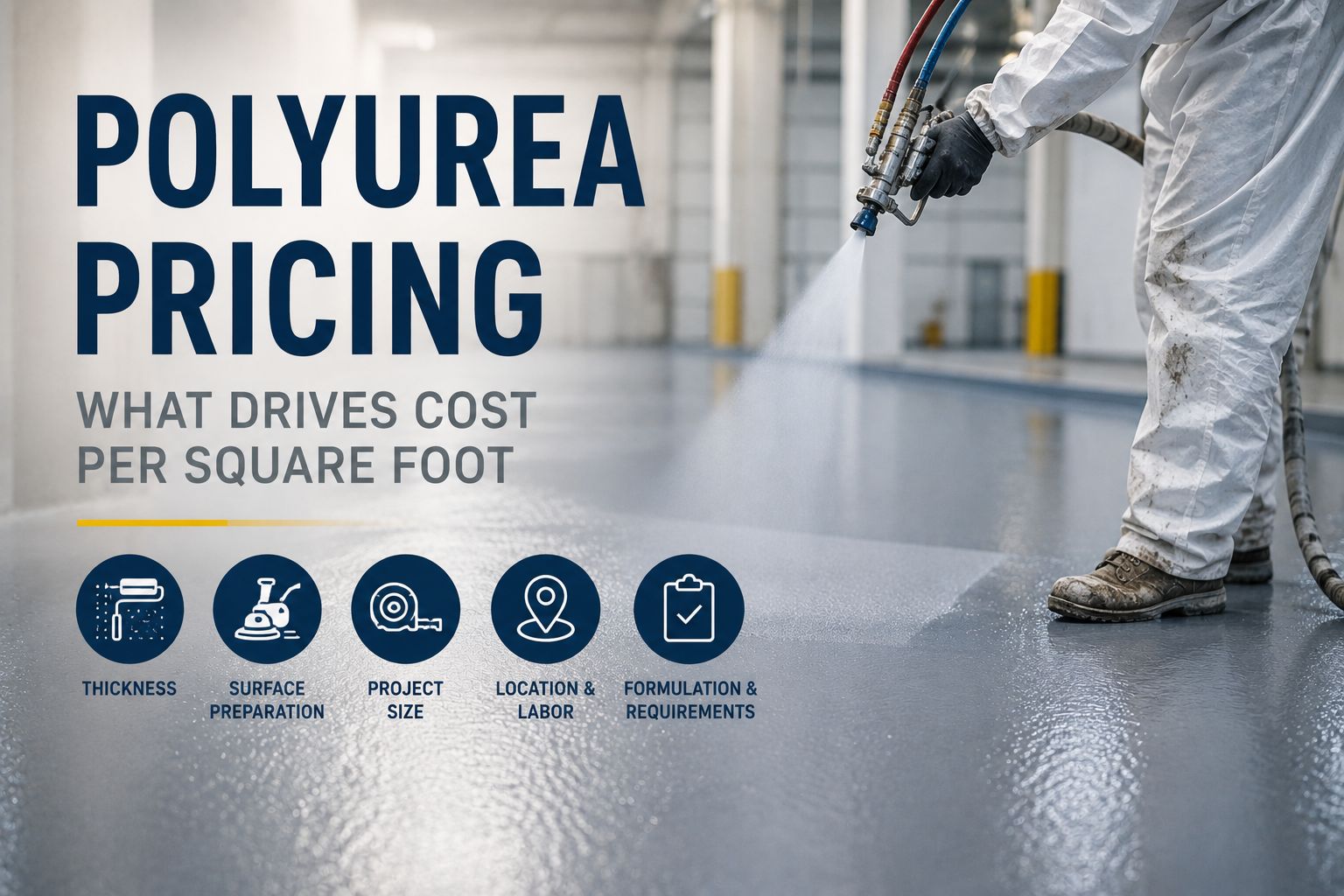
“How much does polyurea cost per square foot?” is one of the most common questions in this industry, and it’s also one of the hardest to answer with a single number. Ask five contractors and you might get five different quotes for what sounds like the same job, and the reason usually isn’t that someone is overcharging. It’s that polyurea pricing depends on a longer list of variables than most buyers expect going in.
This guide breaks down what actually drives polyurea cost per square foot, covering thickness, surface preparation, project scale, regional labor differences, and formulation choices, so you can understand a quote instead of just comparing the final number against a competitor’s bid.
Understanding the Basics
Polyurea is a two-component spray-applied coating, and its price reflects both the material itself and everything that goes into applying it correctly: labor, equipment, surface preparation, and the specific formulation used for the job. A price quoted per square foot is really a shorthand for all of those factors bundled together, which is why the same square footage can produce very different quotes depending on what’s actually involved.
Unlike a simple retail product where price mostly reflects the item itself, a sprayed coating’s cost is dominated by labor and process, not just material. That’s a big part of why DIY kits and professional application can differ so much in price for what looks like a similar end result on paper.
Coating Thickness and Material Volume
Thickness, usually measured in mils, is one of the biggest cost drivers, since it directly determines how much material gets used per square foot. A thin decorative coating uses far less material than a thick, high-build industrial floor coating designed for heavy abrasion or impact resistance. Projects requiring a thicker application, whether for durability, chemical resistance, or a specific performance requirement, will cost more per square foot simply because more material is going down.
Coverage calculations in this industry commonly use a standard of 1,604 square feet per gallon per mil of thickness as a baseline reference for material planning, which gives a sense of how directly thickness and material cost are linked. Doubling the required thickness roughly doubles the material cost for that portion of the job, even before labor is factored in.
Surface Preparation Complexity
Surface prep is often the most underestimated cost factor in a polyurea project. A clean, sound, properly profiled substrate is faster and cheaper to prepare than one with existing coating that needs to be removed, cracks that need repair, or contamination that requires extra cleaning steps before spraying can even begin.
A project quoted low on material and labor for the coating itself can still come in expensive overall if the substrate needed extensive repair work first. Getting an accurate substrate assessment before finalizing a quote is one of the more important steps a buyer can take to avoid surprise costs once work begins.
Project Size and Economies of Scale
Larger projects generally achieve a lower cost per square foot than smaller ones, since fixed costs, equipment setup, mobilization, and crew time that doesn’t scale directly with square footage, get spread across more coated area. A small residential job and a large industrial floor might use the exact same coating formulation but land at very different per-square-foot prices, purely because of project scale.
This is worth keeping in mind when comparing quotes across very different project sizes, since a contractor’s per-square-foot rate on a small job isn’t necessarily representative of what a much larger project from the same contractor would cost.
Labor and Regional Pricing Differences
Labor cost varies by region, reflecting local wage rates, demand for qualified applicators, and how competitive the local contractor market is. A metro area with several established polyurea contractors competing for work often sees different pricing than a region where qualified applicators are scarce and travel is required to reach the job site.
Applicator experience and certification also factor into labor cost. A newer or less specialized crew may quote lower, but inconsistent application quality can lead to problems, and ultimately added cost, down the line. Our overview of polyurea applications covers the range of use cases where application quality matters most, particularly for demanding industrial and commercial settings.
Formulation and Additives
Not all polyurea is priced the same. Aromatic formulations are generally less expensive than aliphatic formulations, which offer better UV stability and color retention but cost more per gallon. Adding a UV-stable topcoat, anti-slip aggregate, or specialized additives for chemical resistance all add to material cost, and each of these choices should be weighed against what the specific application actually needs rather than added by default.
A decorative garage floor and an industrial containment coating have very different formulation requirements, and pricing reflects that difference even when both are technically “polyurea.” Our complete guide to polyurea coating covers how formulation differences affect performance characteristics that ultimately factor into which product makes sense for a given price point.
What a Typical Quote Includes
A complete polyurea quote should break down more than just a single per-square-foot number. Buyers benefit from asking specifically what’s included:
- Surface preparation scope, including any repair work identified during assessment
- Material formulation and target thickness
- Whether a topcoat is included and what it’s rated for
- Labor and mobilization costs, particularly for larger or more remote projects
- Warranty coverage and what it actually protects against
Two quotes that look close on a per-square-foot basis can represent very different scopes of work once these details are compared side by side.
Cost Factors at a Glance
| Factor | Effect on Cost |
|---|---|
| Coating thickness (mils) | Higher thickness increases material cost directly |
| Surface condition | Poor condition adds prep labor and cost before coating begins |
| Project size | Larger projects generally achieve lower cost per square foot |
| Regional labor market | Varies by local wage rates and contractor availability |
| Formulation type | Aliphatic formulations cost more than aromatic due to UV stability |
| Additives and topcoats | Each addition increases material cost, should match actual need |
Things to Consider Before Comparing Quotes
- Does the quote specify target thickness, or just a vague “standard application”?
- Has the substrate actually been assessed, or is the quote based on an assumption of good condition?
- Is the formulation appropriate for the application, aromatic for cost-sensitive interior use versus aliphatic where UV exposure matters?
- What does the warranty actually cover, and for how long?
- Are you comparing quotes for genuinely similar scopes of work, or just similar-sounding per-square-foot numbers?
For a closer look at how polyurea pricing compares against a common alternative, our earlier piece on polyurea versus epoxy for concrete floors breaks down cost alongside performance differences between the two systems.
Hidden Costs Buyers Often Miss
A few costs tend to surface after a project starts rather than showing up in the initial quote, and budgeting for them upfront avoids an unpleasant surprise mid-project. These are the costs that separate an accurate final invoice from a project that quietly runs over budget partway through.
Substrate repair discovered once old flooring, coating, or debris is removed is one of the most common. A surface that looked fine during a walkthrough can reveal cracks, contamination, or moisture issues once the existing surface is stripped away, and addressing those issues properly adds cost that a pre-demolition quote couldn’t fully anticipate.
Downtime costs matter for commercial and industrial buyers in particular. A facility or business that needs to close or relocate operations during application should factor that lost productivity into the true cost of the project, not just the contractor’s invoice.
Touch-up and maintenance costs down the line depend heavily on how well the original job was done. A rushed or under-specified application, chosen to hit a lower initial price, often needs earlier maintenance or a full recoat sooner than a properly specified job would, effectively erasing the upfront savings over the coating’s service life.
Why the Cheapest Quote Isn’t Always the Best Value
A lower per-square-foot price that skips proper surface preparation, uses a thinner application than the project actually needs, or substitutes a less durable formulation to hit a lower number often costs more in the long run once early failure or redo work is factored in. Evaluating quotes on total scope and expected service life, not just the headline number, tends to produce a better outcome than chasing the lowest bid.
Understanding the fundamentals of what polyurea actually is and how it performs helps put pricing into context. Our piece on the basics of polyurea as a coating solution covers the chemistry and performance characteristics that ultimately justify why proper material and application quality cost what they do.
Frequently Asked Questions
Why do polyurea quotes vary so much between contractors?
Pricing differences usually reflect real differences in scope: surface preparation included, target thickness, formulation type, and warranty coverage, not just markup. Comparing what’s actually included in each quote explains most of the price gap.
Is a higher price always a sign of better quality?
Not automatically, but a price that’s dramatically lower than competing quotes for the same scope of work is worth questioning, since it may reflect thinner application, skipped surface prep, or a lower-grade formulation.
Does DIY polyurea application save significant money compared to professional installation?
Material costs are generally lower for DIY kits, but professional application includes labor, equipment, and typically a more consistent, higher-quality result along with warranty coverage that DIY application usually doesn’t include.
How much does coating thickness affect the final price?
Significantly. Since material usage scales directly with thickness, a project requiring a thicker application for durability or chemical resistance will cost more per square foot than a thinner decorative coating, independent of any other factor.
Should I get multiple quotes before choosing a contractor?
Yes, and comparing them on scope of work rather than just the final number is the more useful approach, since two similarly priced quotes can represent very different levels of surface preparation, material quality, and warranty coverage. Asking each contractor to itemize their quote using the same categories, rather than accepting a single bundled number, makes an apples-to-apples comparison much easier.
Conclusion
Polyurea cost per square foot isn’t a fixed number, it’s the sum of thickness requirements, surface condition, project size, regional labor rates, and formulation choices, all bundled into a single figure that can look deceptively simple on a quote. Understanding what’s actually driving that number, rather than comparing bids on price alone, is what separates a buyer who gets good long-term value from one who ends up paying for a redo a few years down the line.
Get polyurea pricing
Tell us what you are coating and roughly how much you need. We will follow up with material pricing and options.