
America’s infrastructure faces a mounting maintenance crisis. Hundreds of thousands of bridges, highway overpasses, parking structures, and public works facilities are aging past their design service lives. Repairing and preserving this infrastructure requires coating systems that perform at the highest level in demanding environments, last decades without failure, and can be applied quickly to minimize public disruption. Polyurea has become an essential tool in the infrastructure preservation toolkit.
Bridge Deck Waterproofing
Bridge decks are among the most demanding coating environments in civil engineering. They must withstand freeze-thaw cycling that can crack rigid coatings, de-icing salts that accelerate corrosion, constant vehicular traffic loads, UV exposure, and ponding water. Traditional waterproofing systems based on modified bitumen, sheet membranes, or epoxy have all shown service life limitations in this environment.
Polyurea bridge deck membranes address these challenges through a combination of properties that no single traditional system can match. Tensile strengths above 3,000 psi give the membrane the structural integrity to bridge cracks. Elongation values above 300 percent allow the membrane to accommodate thermal expansion, contraction, and concrete microcracking without rupturing. Waterproof and seamless by nature, the spray-applied membrane eliminates the seam failures that plague sheet membrane systems at laps and transitions.
State departments of transportation and municipal bridge authorities have increasingly incorporated polyurea specifications into bridge preservation programs. The longer service life of polyurea membranes compared to traditional waterproofing systems reduces the frequency of bridge closures for recoating, which represents a significant savings in both direct cost and public inconvenience over a 50-year asset lifecycle.
Parking Deck Restoration and Protection
Multi-level parking structures represent some of the most challenging concrete coating applications in the built environment. These structures are simultaneously exposed to vehicle traffic, de-icing salt tracked in from highways, carbon monoxide from vehicle exhaust, water infiltration, and the constant stress of vehicles turning and braking. Conventional epoxy traffic coatings have a typical service life of 3 to 7 years in active parking structures before requiring replacement.
Polyurea parking deck systems extend that service life to 15 to 25 years or more under typical use conditions. The combination of abrasion resistance, flexibility, and chemical resistance that makes polyurea effective in other demanding applications translates directly to longer parking deck performance. The faster application and cure time also means parking levels can be reopened to traffic within hours rather than days, reducing revenue loss during restoration.
Water and Wastewater Infrastructure
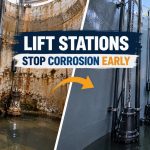
Concrete water and wastewater infrastructure faces a specific and particularly aggressive degradation mechanism: microbially induced corrosion (MIC). Hydrogen sulfide gas produced by anaerobic bacteria in sewers converts to sulfuric acid in the presence of aerobic bacteria on concrete surfaces, attacking the concrete from the inside out. Conventional concrete sealers and epoxy coatings offer limited resistance to MIC because the acid can attack both the coating and the underlying concrete through pinholes and thin spots.
Seamless polyurea liners applied at adequate thickness create an impermeable barrier that physically isolates the concrete substrate from the aggressive environment. Combined with the flexibility to accommodate concrete cracking, polyurea is now widely specified for manhole rehabilitation, lift station liners, wet well protection, and pipe rehabilitation. For a detailed look at one of these applications, read our article on the benefits of polyurea for manhole and sewer linings.
The growing adoption of polyurea by municipalities performing their own infrastructure repairs is documented in our piece on the growing trend of municipalities using polyurea for in-house infrastructure repairs.
Pipeline Corrosion Protection
The United States has over 2.6 million miles of natural gas pipelines and hundreds of thousands of miles of petroleum, chemical, and water pipelines. External corrosion is the leading cause of pipeline failure, responsible for billions of dollars in annual maintenance costs, environmental incidents, and public safety risks. Polyurea pipeline coatings provide the corrosion protection that has fundamentally changed how pipeline operators approach asset protection.
Applied in the factory or in the field, polyurea pipeline coatings form a seamless, high-build barrier that resists cathodic disbondment, soil stress cracking, and mechanical damage during installation. The flexibility of cured polyurea allows it to accommodate the pipeline’s thermal expansion and contraction, ground movement, and vibration without developing the holidays and disbondment that compromise the effectiveness of rigid coating systems.
For a comprehensive look at this application, read our detailed article on how polyurea pipeline coatings changed pipeline protection and repair.
The Economics of Infrastructure Preservation
The economic case for polyurea in infrastructure preservation rests on total lifecycle cost, not just initial application cost. A polyurea bridge deck membrane that costs three times as much as a conventional coating but lasts four times longer at a fraction of the disruption cost represents a clear lifecycle value advantage.
Infrastructure owners are increasingly familiar with this calculus. The Federal Highway Administration and state DOTs have developed lifecycle cost analysis frameworks that favor longer-lasting protective systems even at higher upfront cost. As polyurea’s performance record in bridge, parking, and wastewater applications grows, its position in infrastructure preservation specifications continues to strengthen.
For the broader picture of where the polyurea industry is headed, read Shaping Tomorrow: A Glimpse into the Future of the Polyurea Industry. Infrastructure professionals seeking to understand the application landscape can also visit our polyurea applications page and our industry standards and resources section.