

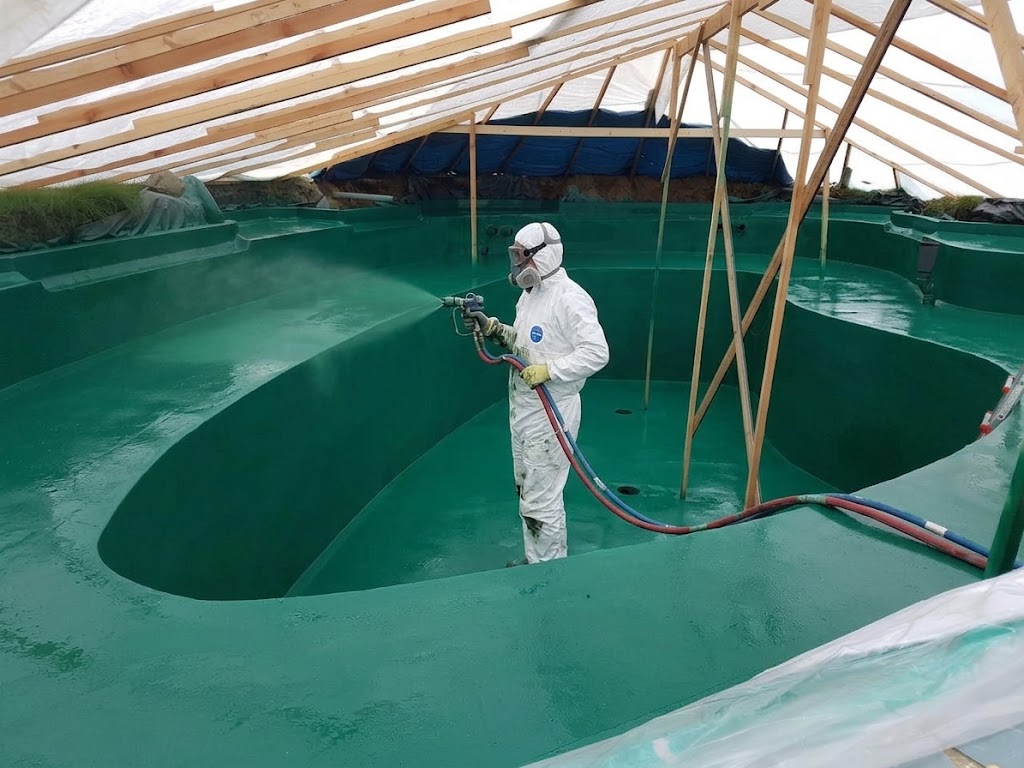
Water is a patient adversary. Give it a pinhole and one season, and it will find the gap behind your liner, wick sideways through the substrate, and surface somewhere you never expected — usually as a soggy patch of lawn thirty feet from the pond it escaped. That ordinary frustration, more than any spec sheet, is why polyurea aquatic coatings have taken over so much of this work.
The short version: polyurea aquatic coatings are spray-applied, seamless waterproofing membranes used to line ponds, koi ponds, streams and waterfalls, aquaculture tanks, reservoirs, fountains, and a long list of other structures that stay wet for a living. They gel in seconds, bond tenaciously to properly prepared concrete, and stretch instead of cracking. That combination is unusual enough that aquatic work went from a novelty in the early 2000s to one of the steadier niches in the industry.
It is also work that punishes shortcuts harder than almost anything else our members spray. A warehouse floor with a holiday in the coating is a maintenance ticket. A pond with a holiday in the coating is a dead fish collection and a very unhappy homeowner.
What Actually Counts as an Aquatic Coating?
The category is broader than most people assume, and the projects share almost nothing except standing water. Ask five contractors where polyurea aquatic coatings get used and you will get five different answers, all correct.
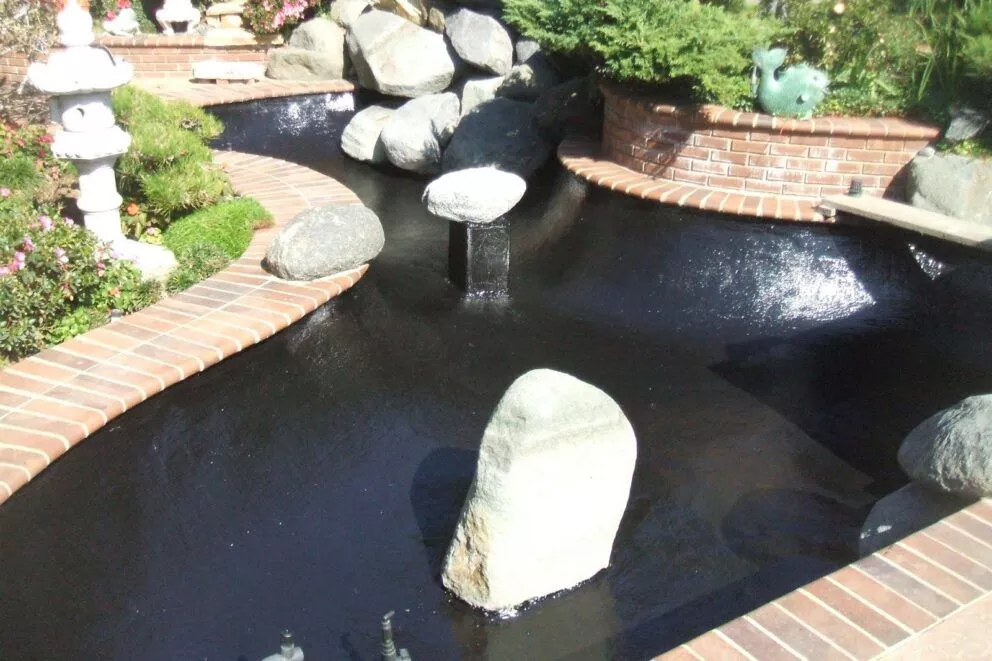
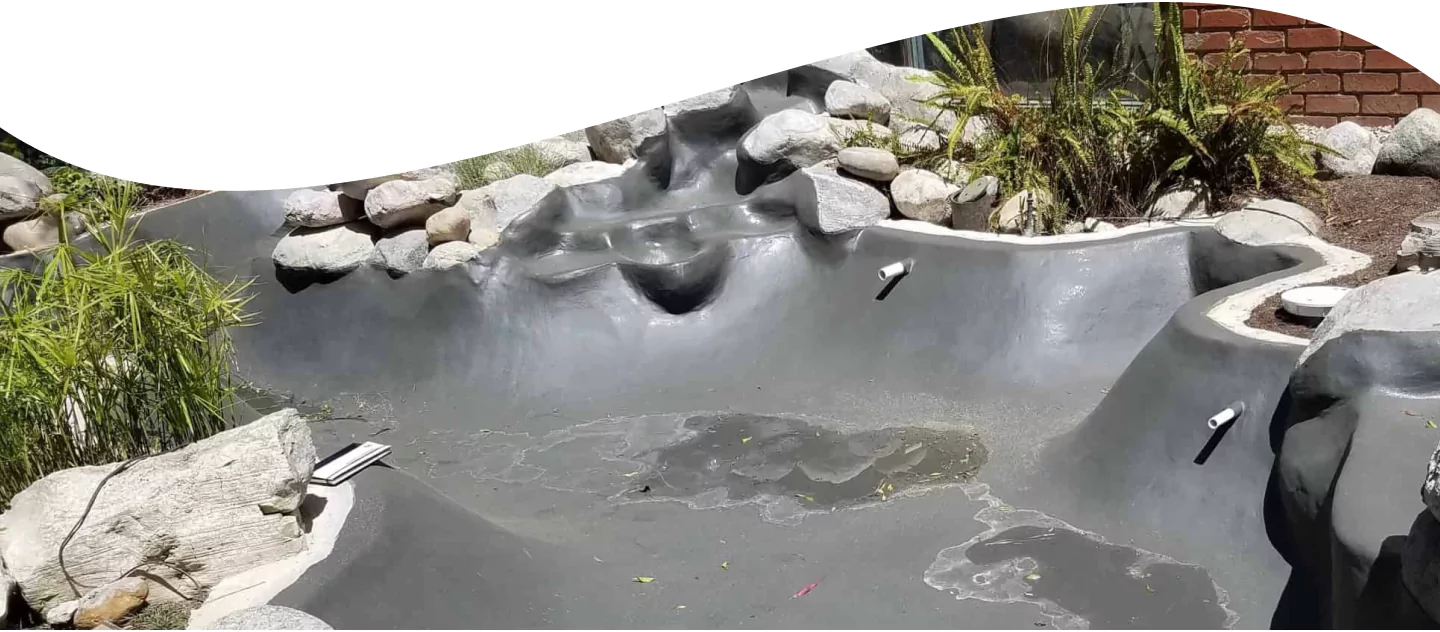
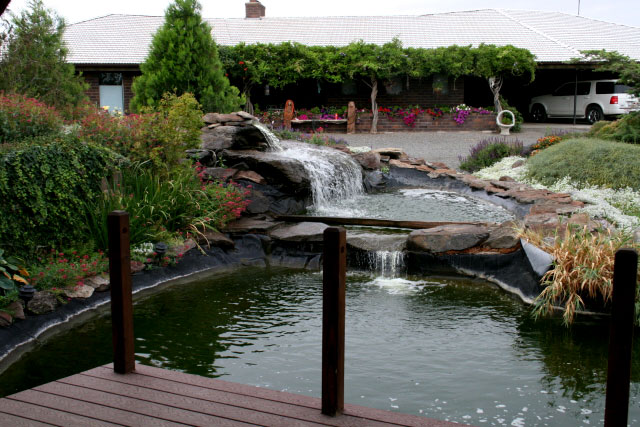
Polyurea aquatic coatings show up in three fairly distinct tiers. On the decorative side you have backyard koi ponds, freeform swim ponds, streams, waterfall weirs, fountain basins, and the rock-and-water features that landscape architects love to draw and nobody enjoys waterproofing. On the commercial side: aquaculture raceways, hatchery troughs, recirculating aquaculture (RAS) tanks, live-haul holding, and tilapia or shrimp grow-out basins. Then there is the institutional tier — zoo and aquarium exhibits, marine mammal pools, touch tanks — where the film has to be inert enough for animals and clean enough to sit behind a public viewing panel.
Further out, still aquatic in the loose sense, sit potable water reservoirs, irrigation canals, clarifier basins, and splash pads. Those bring code and certification questions that a backyard pond does not, which we will get to.
Why Polyurea Aquatic Coatings Took Over the Water Business
Three properties explain why polyurea aquatic coatings displaced older methods on this kind of work, and none of them is about raw strength.
Seams Are Where Liners Die
Sheet goods work. EPDM, PVC, and RPE liners have held water for decades and will keep doing it. The trouble is geometry. Every fold, every seam, and every place a boulder pinches the membrane against a sharp concrete edge is a future leak with a date on it. A rock waterfall with forty stones set into it is forty chances to get it wrong.
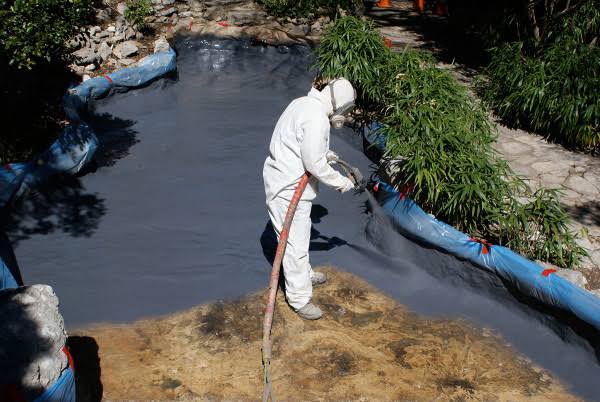
Spray polyurea sidesteps the problem by not having seams. It goes down as one continuous film that follows undercuts, coves, radii, penetrations, and whatever shape the shotcrete crew actually built — as opposed to what the drawing said. Overspray onto adjacent stone is usually a feature rather than a defect, since you can carry the membrane up and over a rock face and terminate it somewhere it will never be seen.
It Moves, Which Is the Whole Point
Pond shells move. Soil swells, frost heaves, shotcrete shrinks, and hairline cracks open up in the first two winters. Most aquatic polyurea systems run somewhere between 300 and 600 percent elongation with tensile strength in the 2,000 to 3,000 psi range, so a crack that would telegraph straight through a rigid coating gets bridged instead. Epoxy cannot do that; it is stronger in some respects and far more brittle in the one respect that matters here. We dug into that trade-off in our comparison of spray polyurea versus roll-on epoxy.
Speed Changes the Job Economics
Most polyurea aquatic coatings gel in five to fifteen seconds, which means a crew can coat a 2,000 square foot shell in a morning and walk it that afternoon. On a commercial hatchery, where every day of downtime is a lost production day, that is frequently the entire reason polyurea wins the bid. Just do not confuse tack-free with ready-for-fish. Those two are days apart, and the difference matters more than anything else in this article.
The Fish Question: Can You Actually Put Koi in It?
This is the first question anyone asks about polyurea aquatic coatings, and the honest answer carries more nuance than most marketing copy admits.
A fully reacted polyurea film is essentially inert. The isocyanate and the amine resin consume each other during the reaction, and what remains is a cross-linked solid with nothing meaningful left to give up to the water. Thousands of koi ponds and commercial fish tanks have run fifteen years and longer on sprayed polyurea without incident.
The risk is not the cured film. The risk is material that never cured properly. Off-ratio polyurea — pump imbalance, a cold A-side, a partially plugged mix chamber — stays soft, tacky, and chemically unfinished, and that material can absolutely leach. So can solvent carried in from a primer that got topcoated too early, and so can the dry, powdery rebound that piles up in corners on a hot day. Every fish loss we have heard traced back to a coating has been an application problem, not a chemistry problem. If your ratios and temperatures are not dialed in, read up on polyurea viscosity and reactivity before you take on livestock work.
A reasonable field protocol looks like this. Cure per the manufacturer data sheet, usually 24 to 72 hours and longer when it is cold. Vacuum out every bit of loose rebound. Fill the system and dump it at least once. Refill, circulate through filtration for several days, then test ammonia, nitrite, pH, and hardness before anything living goes in. Introduce two or three inexpensive fish first and give them a week. Nobody has ever regretted that step.
Potable water is a different question entirely. For reservoirs, cisterns, and drinking water tanks the issue is not whether it is safe for fish but whether it is certified. NSF/ANSI 61 listings apply to a specific product at a specific thickness on a specific substrate — not to polyurea as a family. Ask for the listing document, not a reassurance. The NSF listing search is public, so verifying takes about two minutes. Our piece on polyurea cistern liners walks through how that plays out on tank work.
What Good Aquatic Work Looks Like on Site
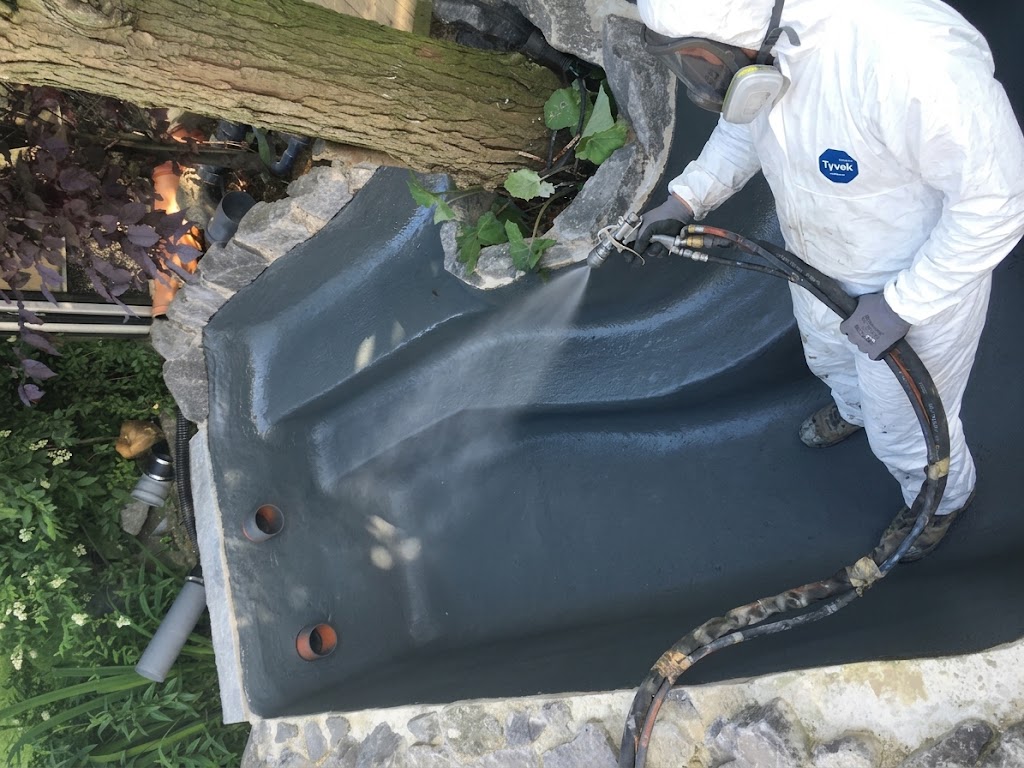
Preparation determines whether polyurea aquatic coatings last far more than product selection does. Concrete and shotcrete should be fully cured, with 28 days as the usual benchmark, and rushing that is the single most common cause of blisters we hear about. Abrasive blast or grind to a CSP 3 to 5 profile, get the moisture content down, and test it rather than guessing. A calcium chloride or in-situ RH test costs almost nothing next to a re-spray.
From there: an epoxy moisture-vapor-barrier primer on anything below grade or near a water table, coving at the wall-to-floor transition, and terminations that end in a saw kerf or keyed edge well above the maximum waterline. A termination that stops an inch above the water is not a termination. It is a wick.
Penetrations are where careful crews separate themselves from busy ones. Bottom drains, bulkhead fittings, skimmer boxes, and returns each need mechanical sealing plus sealant plus coating, in that order. The membrane is a waterproofing layer, not a gasket. Detail every one of them before you pull the trigger and photograph the work, because you will not see any of it again once the water is in.
For the full walkthrough on profiling, moisture testing, and priming decisions, our polyurea surface preparation field guide is the deeper reference.
Specifying Thickness
Published thickness ranges for polyurea aquatic coatings vary by manufacturer, so treat the table below as a starting point for conversation rather than a specification. Verify everything against the product data sheet you are actually spraying.
| Application | Typical DFT | What drives it |
|---|---|---|
| Decorative koi pond, water feature | 60–90 mils | Extra build at coves and rock transitions |
| Swim pond / natural pool | 80–125 mils | Non-skid broadcast on beach entries and steps |
| Aquaculture raceway, hatchery tank | 100–125 mils | Cleaning and netting abrasion |
| Zoo or aquarium exhibit | 100–160 mils | Often an aliphatic topcoat for color stability |
| Potable reservoir or cistern | Per NSF listing | Thickness is part of the certification |
For the wider context on how thickness gets specified across the rest of the industry, see how thick polyurea should be by application type.
Where Polyurea Aquatic Coatings Go Wrong
Blistering leads the list of complaints about polyurea aquatic coatings, and it is almost always moisture rather than the coating. Vapor pushing up through a slab with no drainage, a high water table behind a pond wall, a shell that was still green when it got coated. Polyurea is an excellent vapor retarder, which is precisely why trapped moisture has nowhere to go except into a blister. Drainage, a vapor barrier primer, and patience solve it.
Second is under-thickness in the places that need it most: tight coves, the inside of radii, the shadowed underside of a boulder overhang. Wet film gauges and a disciplined pass pattern fix this. Nobody enjoys crawling a shell with a mil gauge. Everybody enjoys it more than draining a full pond in year three.
Third, UV. Aromatic polyureas chalk and fade, so a black liner drifts toward a dusty charcoal above the waterline over a few seasons. Below water it is irrelevant. Above water it is cosmetic rather than structural, and either an aliphatic topcoat or a frank conversation with the client handles it. We would rather set expectations than sell a topcoat nobody needs.
Fourth, recoating existing liners. Spraying polyurea over old EPDM sounds efficient and occasionally works, but plasticizers, silicone contamination, and unbonded sheet flapping underneath make it a gamble. Run an adhesion test, or cut the old liner out.
Cold weather adds its own list. The Polyurea Development Association and AMPP both publish guidance worth reading before you bid winter aquatic work. Substrate temperature, hose heat, and dew point all shift, and aquatic shells hold cold far longer than you expect because they sit in the ground. Our cold climate application guide covers those adjustments.
Texture, Color, and the Algae Argument
Most polyurea aquatic coatings go down black or charcoal, and there is a practical reason beyond looks. Dark liners vanish under water and make a pond read as deep. Gray and tan show up on natural-pool work where the designer wants a shallow, sandy feel.
Texture is a real decision, not an afterthought. A slight orange peel or a broadcast aggregate gives fish something to work against in a raceway and keeps a swim pond beach entry from turning into a slide. Smooth film cleans faster and inspects easier. You cannot have both, so pick based on who is using the water.
On algae, we will push back gently on a claim you hear constantly. A smooth liner does not prevent algae. Algae responds to nutrients, light, and circulation. A smooth liner makes algae easier to brush off, which is genuinely useful, but no coating is an algae solution and anyone selling it as one is overreaching.
What It Costs and What That Buys
Installed pricing generally lands between roughly four and nine dollars per square foot in the United States, with small, complicated, hand-detailed water features pushing higher because masking and mobilization dominate the labor. That looks expensive next to a dollar-fifty sheet liner right up until you price a failure.
Draining a mature koi pond means catching and boarding fish, losing an established biological filter, tearing out and resetting stone, and rebuilding a landscape. Owners who have been through it once tend to make a different decision the second time. Service life on a properly applied aquatic system typically runs fifteen to twenty-five years, and spot repairs are straightforward: abrade, prime the edge, and re-spray or hand-apply a patch that fuses into the original film.
Quick Answers
A few questions come up on nearly every polyurea aquatic coatings inquiry we field. More general questions are answered in our polyurea FAQ, and unfamiliar terms are defined in the glossary.
Is polyurea safe for fish?
Properly applied and fully cured, polyurea aquatic coatings are safe for fish, with the flush-and-test protocol described above. Failures trace back to off-ratio or under-cured material rather than to the chemistry. For livestock and display animals, get written confirmation from your manufacturer for the specific product you are spraying.
How long until I can fill and stock?
Filling is usually fine within 24 to 48 hours. Stocking is a separate question. Plan on at least one fill-and-dump cycle plus several days of circulation and water testing first.
Will it bond to shotcrete and gunite?
Yes, and they are among the better substrates for it, provided the shell is cured, profiled, and dry. The rough surface of gunite actually helps mechanical adhesion.
Can polyurea be rolled on instead of sprayed?
True polyurea sets far too fast to roll. Slow-set hybrids and brush-grade repair materials exist for detail and patch work, but the body of an aquatic liner needs plural-component spray equipment and a heated proportioner. Our equipment buyer guide covers what that costs.
Does it work on metal or fiberglass tanks?
Often, yes. Steel needs blasting to near-white plus an appropriate primer. Fiberglass needs abrasion and an adhesion test, since gel coat release agents cause real trouble. The marine and splash zone guide covers the metal side in detail, and secondary containment covers the tank farm equivalent.
Where to Go From Here
Polyurea aquatic coatings reward applicators who like details and punish the ones in a hurry. If you are specifying polyurea aquatic coatings, start with the substrate and the animals, then let those drive the product selection rather than the other way around. If you are looking for someone to do the work, our applicator directory is the place to start, and the complete guide to polyurea coatings covers the fundamentals underneath everything above.
Questions about a specific pond, tank, or exhibit? Get in touch and we will point you toward members who spray this work every week.
Get polyurea news in your inbox
New articles, application guides and industry news from American Polyurea. Unsubscribe anytime.