

Anyone specifying a coating for a concrete floor eventually runs into the same decision: polyurea vs epoxy floor coating, which one actually fits the job. Epoxy has been the default choice for decades and still gets specified more than any other system. Polyurea has moved into a lot of the same projects over the past several years, marketed as the faster, tougher alternative. Both claims have some truth to them, and both coatings have real limitations that don’t always make it into the sales pitch. The useful question isn’t which one wins in the abstract. It’s which one actually holds up under the specific traffic, chemical exposure, and schedule constraints of the floor in front of you.
Understanding the Basics
Epoxy floor coatings are the reaction product of an epoxy resin and a hardener, applied as a liquid that cures into a hard, glossy film. Epoxy bonds well to properly prepared concrete and resists a wide range of chemicals and stains, which is why it remains common in garages, warehouses, and light industrial settings. The tradeoff is cure time: epoxy needs an extended window, often 24 hours or more, before it can handle foot traffic, and longer before it takes vehicle or heavy equipment loads. It also tends to become brittle over time and under impact, and standard epoxy can amber or discolor under UV exposure without a protective topcoat.
Polyurea is a fast-reacting coating, often applied by spray, and can cure much faster than conventional epoxy systems. The exact cure and return-to-service time depends on the formulation, substrate conditions, temperature, and the manufacturer’s technical data sheet. That speed advantage comes from its chemistry: pure polyurea forms through an amine-to-isocyanate reaction that doesn’t need a catalyst and is generally less disrupted by ambient moisture than epoxy. Beyond cure speed, polyurea holds flexibility across a wider temperature range and resists cracking under impact better than a rigid epoxy film. For a deeper look at the chemistry driving these differences, our complete guide to polyurea coatings covers the reaction basics in more depth.
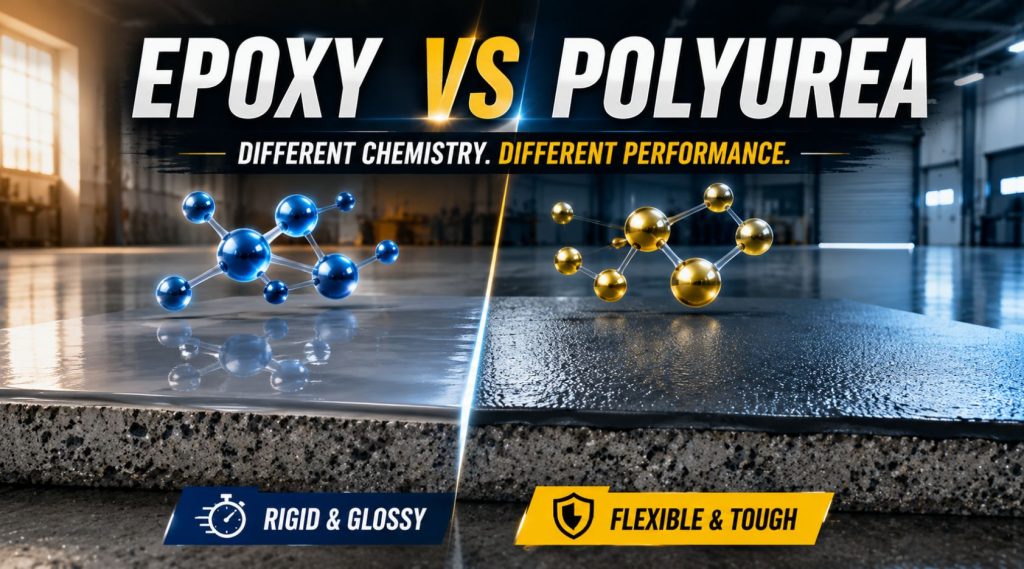
Polyurea vs Epoxy Floor Coating: Key Differences
Cure time. Epoxy needs roughly a day or more before return to service. Polyurea can significantly shorten that return-to-service window compared with conventional epoxy, although the actual timing depends on the specific system and job conditions, which matters most for facilities that can’t absorb a multi-day shutdown.
Flexibility. Epoxy is a rigid film and can crack under impact or slab movement. Polyurea stays more flexible, which helps it handle thermal cycling and minor substrate movement without cracking.
Moisture tolerance during application. Epoxy’s cure is more sensitive to ambient humidity and substrate moisture. Polyurea is generally less sensitive to ambient moisture during application, but substrate moisture and surface preparation still need to be properly evaluated for the specific system.
Chemical resistance. Both hold up well against common chemicals and stains, though the specific resistance profile depends on the exact formulation used, not the general category. Anyone with a specific chemical exposure list should check the manufacturer’s technical documentation for the exact product being considered, not a general comparison.
UV stability. Standard epoxy without a UV-stable topcoat tends to amber or yellow with sun exposure. Polyurea’s UV performance depends heavily on the specific formulation, and a UV-stable topcoat is often needed on either system if it will see direct sunlight long-term.
Abrasion resistance. Both systems handle foot and light wheeled traffic well when properly installed. Under heavy or constant abrasion, film thickness and the specific product formulation matter more than which broad category the coating falls under.
Cost. Epoxy systems generally carry a lower material cost than polyurea. Polyurea’s higher price reflects both the raw material cost and the specialized spray equipment required to apply it correctly.
Comparison Table
| Factor | Epoxy | Polyurea |
|---|---|---|
| Cure time | Hours to over a day | Much faster; system-dependent |
| Flexibility | Rigid, can crack under impact | More flexible across temperature swings |
| Moisture sensitivity during cure | Higher | Low |
| UV stability without topcoat | Ambers over time | Depends on formulation; topcoat may be needed for long-term UV exposure |
| Abrasion resistance | Strong, formulation-dependent | Strong, formulation-dependent |
| Typical cost | Lower | Higher |
| Common setting | Garages, light industrial, decorative floors | Fast-turnaround industrial floors, high-traffic areas |
Best Use Cases
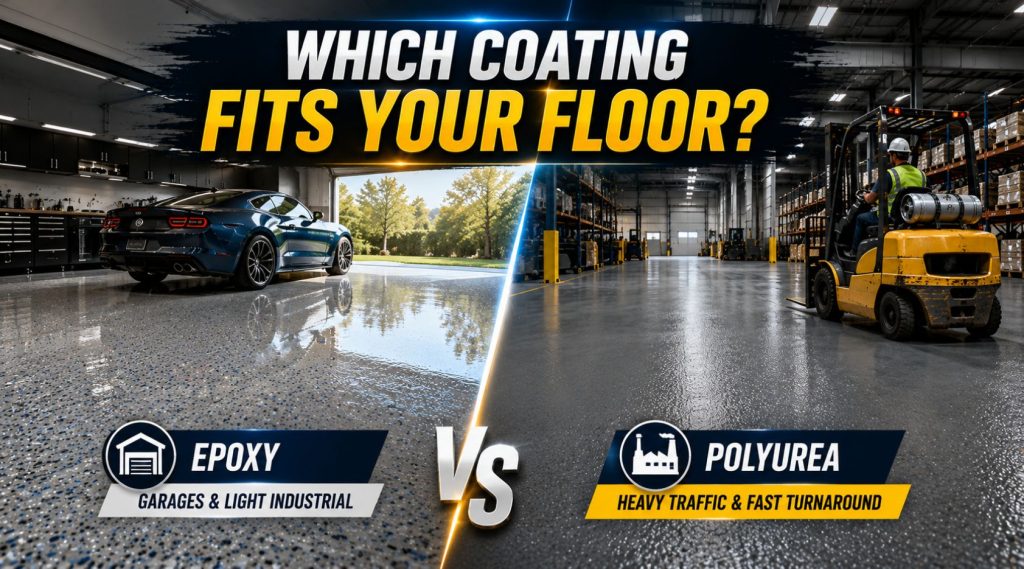
Epoxy remains a solid choice for garage floors, showroom floors, light industrial spaces, and decorative applications where a glossy, customizable finish matters and the facility can absorb a longer cure window before the floor goes back into service. It also has a strong track record and a lower upfront cost, which keeps it the default for budget-conscious projects without heavy traffic demands.
Polyurea tends to be the better fit for facilities that can’t shut down for an extended period, floors that see heavy forklift or wheeled traffic, and settings with wide temperature swings or impact exposure where a rigid epoxy film is more likely to crack. For a broader look at where polyurea gets specified across different industrial settings, our applications and use cases page breaks down the common scenarios by industry, and our guide on industrial concrete floor coating systems goes deeper into how coating choice interacts with facility downtime specifically.
Things to Consider Before Choosing
Surface preparation matters more than the coating choice. Neither epoxy nor polyurea will perform if the concrete wasn’t properly profiled, moisture tested, and cleaned before application. A well-prepared floor with the “wrong” coating will often outperform a poorly prepped floor with the “right” one.
Ask about the actual cure schedule for your project. Manufacturers publish cure times for standard conditions, but temperature and humidity on the day of application can shift those numbers. Get a realistic return-to-service estimate from the contractor, not just the product data sheet default.
Confirm what topcoat, if any, is included. Both epoxy and polyurea base coats can benefit from a UV-stable topcoat if the floor will see sun exposure. Ask specifically whether that’s part of the quote or an added cost.
Get the technical data sheet for the specific product. “Epoxy” and “polyurea” are broad categories. Performance numbers, chemical resistance, and recommended film thickness vary by manufacturer and formulation, so the actual product documentation should drive the final decision, not a general category comparison.
Factor in the full lifecycle cost, not just the install price. A lower upfront cost on an epoxy system can be offset over time if the floor needs more frequent recoating in high-traffic zones, or if a facility loses production time to a longer cure window on every recoat cycle. Polyurea’s higher install cost sometimes pencils out better once downtime and recoat frequency are part of the comparison, though this varies enough by facility that it’s worth running the numbers for the specific project rather than assuming either direction.
Ask how the contractor handles joints and transitions. Both coating types need proper detailing at control joints, drains, and wall transitions. Poor detailing in these areas is a common source of early failure regardless of which coating was used.
Coverage and Planning
Coverage for either coating type follows the same basic math: one gallon spread at one mil thickness covers 1,604 square feet. Actual coverage on a given job depends on the specified dry film thickness for the product and system in question, so coverage estimates should come from the manufacturer’s technical data sheet for the exact product and film build specified, not a generic assumption applied across brands.
Common Mistakes When Comparing the Two Systems
Comparing marketing claims instead of technical data sheets. A lot of the “polyurea is always better” or “epoxy is proven and reliable” messaging out there is written to sell one system, not to help a buyer make a decision. The actual technical data sheet for the specific product being quoted tells you far more than a general category comparison ever will.
Ignoring the substrate condition. Buyers sometimes assume the coating alone determines the outcome. In practice, an aging slab with unaddressed moisture issues, active cracking, or contamination will undermine either coating system, and no amount of comparing polyurea vs epoxy floor coating specs will fix a substrate problem that was never diagnosed.
Choosing based on price alone. Epoxy’s lower upfront cost is real, but a facility that needs to close for a full day or more to let a coating cure has a cost too, even if it doesn’t show up on the coating invoice. Lost production time, rescheduled shifts, and delayed operations are part of the real cost of a slower-curing system, and they belong in the comparison alongside the material price.
Assuming one contractor’s experience applies universally. A contractor who mainly installs epoxy will naturally lean toward recommending it, and the reverse is true for a polyurea specialist. That’s not necessarily bad advice, but it’s worth getting a second opinion, especially on a large or complex floor, before committing to either system based on a single recommendation.
Maintenance
Both systems are relatively low-maintenance once cured, but neither is maintenance-free. Epoxy floors typically need periodic recoating in high-wear areas as the topcoat wears thin, and impact damage should be patched before it spreads. Polyurea floors hold up well under abrasion but still benefit from routine inspection at seams, transitions, and high-traffic zones. Cleaning products should be checked against the coating manufacturer’s recommendations, since some solvents and abrasive cleaners can dull a finish or shorten its service life faster than normal wear would.
Frequently Asked Questions
Is polyurea always better than epoxy for concrete floors?
No. Polyurea has real advantages in cure speed and flexibility, but epoxy remains a reasonable, lower-cost choice for floors with lighter traffic and no urgent downtime constraint.
Can polyurea be applied over an existing epoxy floor?
In some cases, yes, but it depends on the condition and adhesion of the existing coating. A contractor should assess the existing floor before assuming a direct overlay will bond properly.
Why does polyurea cost more than epoxy?
The raw materials and the specialized proportioning equipment required for polyurea’s fast reaction both add cost compared to a standard epoxy system.
Does epoxy crack more than polyurea?
Epoxy is a more rigid film and is generally more prone to cracking under impact or slab movement than polyurea, which retains more flexibility.
How long before a polyurea floor can handle forklift traffic?
This depends on the specific product and film thickness used. The manufacturer’s technical documentation for the exact system applied is the reliable source, not a general industry estimate.
Is a combination of both ever used on the same floor?
It’s less common than choosing one system, but some projects use a polyurea base for speed and flexibility with an epoxy or polyurethane topcoat for a specific finish or chemical resistance need. Whether that makes sense depends on the project’s requirements and should be discussed with the contractor rather than assumed.
Making the Call
When it comes down to a polyurea vs epoxy floor coating decision, there isn’t a single right answer that applies to every facility. A distribution center running three shifts with no downtime window has a very different calculus than a small showroom that can close for a weekend. Traffic type, chemical exposure, schedule flexibility, and budget all factor into which system actually makes sense, and none of those variables show up in a generic product comparison. The most reliable path is getting a site-specific assessment, asking for the technical data sheet on the exact product being proposed, and matching the coating to the conditions the floor will actually face rather than to whichever system a contractor happens to specialize in.
Conclusion
Epoxy and polyurea both have a place on concrete floors, and the right choice depends on traffic, schedule, and budget more than any inherent superiority of one chemistry over the other. Epoxy remains a dependable, lower-cost option for floors that can absorb a longer cure window. Polyurea earns its higher price tag on floors where downtime, flexibility, and fast turnaround actually matter. Either way, proper surface preparation and the right technical documentation for the specific product matter more than the coating category alone.