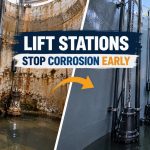

There’s a specific moment in a lift station’s life where a relatively straightforward lift station coating project stops being an option and a much more expensive structural repair becomes the only remaining choice. Most municipalities don’t know exactly when that moment happened until well after they’ve crossed it, because the deterioration that leads there doesn’t announce itself with a dramatic failure. It creeps, one inspection cycle at a time, until the wet well that could have been coated for a modest cost now needs partial reconstruction.
This guide walks through how that deterioration actually progresses, the specific signs that mark each stage, and why understanding this staging matters more than most facilities realize when it comes to protecting the budget as much as the structure itself.
The Deterioration Timeline Nobody Watches Closely Enough
Corrosion inside a wet well doesn’t move at a constant pace, and it doesn’t stay contained to a cosmetic problem indefinitely. It starts with surface-level attack, the sulfuric acid produced by bacteria feeding on hydrogen sulfide gas beginning to soften and etch the concrete surface above the waterline. At this stage, the damage is real but shallow, and a lift station coating applied now stops the process almost entirely, since there’s sound, structurally intact concrete underneath the surface damage for the coating to bond to.
Left unaddressed, that surface attack deepens. The softened layer sloughs away, exposing fresh concrete to the same bacterial and acid cycle, and the process repeats, consuming material at an accelerating rate since there’s no protective barrier interrupting it. This is the stage where a straightforward coating project starts requiring more substrate repair first, still very achievable, but no longer as simple as coating over sound material.
Eventually, enough material loss compromises actual structural capacity, exposed reinforcing steel in reinforced concrete structures, significant wall thinning, or loss of section that affects the wet well’s ability to bear the loads it was designed for. Once a lift station reaches this stage, coating alone isn’t a solution anymore. The project now involves structural repair or reconstruction, with coating as one part of a much larger and more expensive scope of work.
Why This Progression Catches Facilities Off Guard
Lift stations, precisely because they’re functional infrastructure rather than public-facing structures, don’t get the routine visual attention a more visible asset would. A facility might go years between detailed internal inspections, and the gap between “we should look into that surface damage we noticed last time” and “the wall has lost significant structural capacity” can close faster than an infrequent inspection schedule would catch.
Our explainer on the H2S corrosion cycle that drives this kind of damage covers the underlying chemistry in more detail, and one of the most important points from that mechanism is that the cycle is self-sustaining. It doesn’t slow down or stabilize once it starts. Every bit of concrete the acid consumes exposes fresh material for the same bacteria to attack next, which means a lift station left unaddressed doesn’t plateau at a stable level of damage, it keeps progressing toward the structural threshold at a pace that depends on hydrogen sulfide concentration, temperature, and how much exposed surface area the wet well presents above the waterline.
What a Lift Station Coating Project Looks Like at Each Stage
Catching corrosion at the surface stage is the best-case scenario, both financially and practically. A lift station coating applied to sound concrete with only surface-level etching requires straightforward preparation, cleaning and profiling the existing surface, and a coating system chosen for the specific chemical exposure the wet well experiences. Project cost, downtime, and complexity are all at their lowest at this stage.
At the intermediate stage, where surface damage has progressed to more significant material loss but hasn’t yet compromised structural capacity, the project scope grows to include substrate repair before coating, patching or resurfacing the deteriorated areas to restore a sound bonding surface. This is still fundamentally a coating project, just a more involved one than catching the problem at stage one.
Once structural loss has occurred, the project is no longer primarily a coating decision. Structural engineering assessment, repair or reconstruction of the compromised sections, and significantly more cost and downtime become part of the scope, with coating applied as the final protective step once the structural work is complete rather than as the primary intervention.
The Financial Case for Catching This Early
The cost difference between these three stages isn’t a modest percentage increase, it’s often an order-of-magnitude difference between a routine maintenance coating project and a structural rehabilitation project requiring engineering assessment, extended downtime, and significantly more material and labor. This is the practical argument for treating regular wet well inspection as a genuine budget priority rather than a task that competes for attention with more visible infrastructure needs.
A facility that inspects its lift stations on a defined, regular schedule and acts on surface-stage findings promptly spends less over the long run than one that defers inspection and ends up managing structural emergencies reactively. The math favors proactive coating programs consistently, even though the upfront visibility of “we’re spending money on a lift station that isn’t currently failing” can be a harder budget conversation than an emergency repair that arrives with its own obvious urgency attached.
What to Actually Look For During Inspection
Surface texture is the earliest indicator worth checking, a softened, slightly spongy feel where concrete should be hard and solid, particularly at the pipe crown and anywhere above the normal waterline where the corrosion cycle concentrates. Discoloration, a lighter or chalky appearance compared to sound concrete elsewhere in the structure, often accompanies this early surface attack.
As deterioration progresses, visible sloughing or material that can be scraped away by hand becomes apparent, along with a rougher, more irregular surface texture where material loss has become uneven. At the most advanced stage, exposed reinforcing steel, visible section loss, or structural cracking indicate the threshold has already been crossed, and the conversation needs to shift from coating to structural assessment immediately.
Lift Station Corrosion Stages at a Glance
| Stage | Condition | Appropriate Response |
|---|---|---|
| Surface attack | Softened or etched surface, sound concrete underneath | Straightforward lift station coating, minimal prep beyond cleaning and profiling |
| Progressive material loss | Sloughing, uneven surface, deeper deterioration | Substrate repair followed by coating |
| Structural loss | Exposed reinforcement, significant section loss | Structural engineering assessment and repair, coating as final step |
Things to Consider for a Proactive Lift Station Program
- Does your inspection schedule actually match the corrosion risk profile of each specific lift station, or is every station on the same generic interval regardless of known hydrogen sulfide exposure?
- Are inspection findings actually triggering prompt action at the surface stage, or do minor findings tend to get deferred until they’re no longer minor?
- Has staff been trained to recognize the specific early signs, softened surface texture, discoloration, that distinguish surface-stage attack from cosmetic aging?
- Is the budget process set up to fund proactive coating projects, or does funding only become available once a problem is severe enough to qualify as an emergency?
- For stations already showing intermediate or advanced deterioration, has a proper assessment determined which stage the structure is actually at, rather than assuming based on outward appearance alone?
For a broader look at how coating material choice factors into a rehabilitation decision once a lift station needs more than routine maintenance, our comparison of manhole rehabilitation methods covers material tradeoffs that apply to lift station wet wells facing the same underlying corrosion mechanism. Our piece on the benefits of polyurea for manhole and sewer linings covers why this particular chemistry has become a common choice specifically for this kind of aggressive, acid-driven corrosion environment.
Building Lift Station Coating Into a Broader Maintenance Program
Treating lift station protection as an ongoing program rather than a one-time project pays off precisely because the corrosion cycle never stops on its own. Our overview of polyurea applications covers the range of infrastructure and industrial settings where this same proactive-versus-reactive logic applies, and lift stations are a particularly clear example of how much the timing of intervention affects total project cost over an asset’s service life.
Frequently Asked Questions
How quickly does lift station corrosion progress from surface damage to structural loss?
It varies significantly based on hydrogen sulfide concentration, temperature, and the specific structure’s exposure conditions, which is exactly why regular inspection matters more than assuming a fixed timeline applies universally.
Can a lift station coating be applied over existing surface corrosion?
Surface-level etching on otherwise sound concrete generally just needs proper cleaning and profiling before coating. Deeper deterioration needs substrate repair first, and structural-level loss needs engineering assessment before coating is even the relevant conversation.
Is it cheaper to wait and coat a lift station once, rather than inspecting and maintaining it regularly?
Generally no. The cost difference between catching corrosion at the surface stage versus after structural loss has occurred is typically far more than the cumulative cost of regular inspection and earlier, smaller interventions.
What’s the earliest sign of lift station corrosion worth watching for?
A softened or slightly spongy surface texture where concrete should be hard, along with discoloration compared to sound concrete elsewhere in the structure, particularly above the normal waterline.
Does every lift station need the same inspection frequency?
Not necessarily. Stations with higher hydrogen sulfide exposure, warmer operating temperatures, or a documented history of corrosion issues generally warrant more frequent inspection than stations with a lower risk profile.
Conclusion
Lift station coating is at its most cost-effective and least disruptive when it happens at the surface-attack stage, before the self-sustaining corrosion cycle has had time to consume enough material to threaten structural capacity. The window for that straightforward intervention doesn’t stay open indefinitely, and it closes without any dramatic warning, just a gradual progression that regular, genuinely attentive inspection is the only reliable way to catch in time. Municipalities that treat lift station inspection as a real budget priority, not an afterthought competing with more visible infrastructure needs, consistently spend less over the long run than those that wait for a problem serious enough to demand attention on its own.