
Ask five facility managers what the “best” industrial floor coating is and you’ll likely get five different answers, and honestly, all five could be right for their specific building. The real question isn’t which system wins in the abstract. It’s which system fits the traffic, the chemical exposure, the substrate condition, and, just as often overlooked, how many days the facility can actually afford to have that floor out of service.
This guide walks through the main coating systems used in industrial settings, what proper surface preparation actually involves, and how those two factors together determine the downtime a facility should realistically plan for.
Understanding the Basics
Industrial concrete floor coatings exist to solve problems bare concrete can’t handle on its own: abrasion from forklift and foot traffic, chemical spills, moisture intrusion, and the simple wear of years of heavy use. Concrete itself is porous and relatively soft compared to what many industrial environments demand, so a coating system adds a protective, often chemically resistant, layer on top.
The coating itself, though, is only half the equation. How well that coating bonds to the substrate underneath depends almost entirely on surface preparation, which is why two facilities using the identical coating product can end up with very different results based on how the concrete was prepped beforehand.
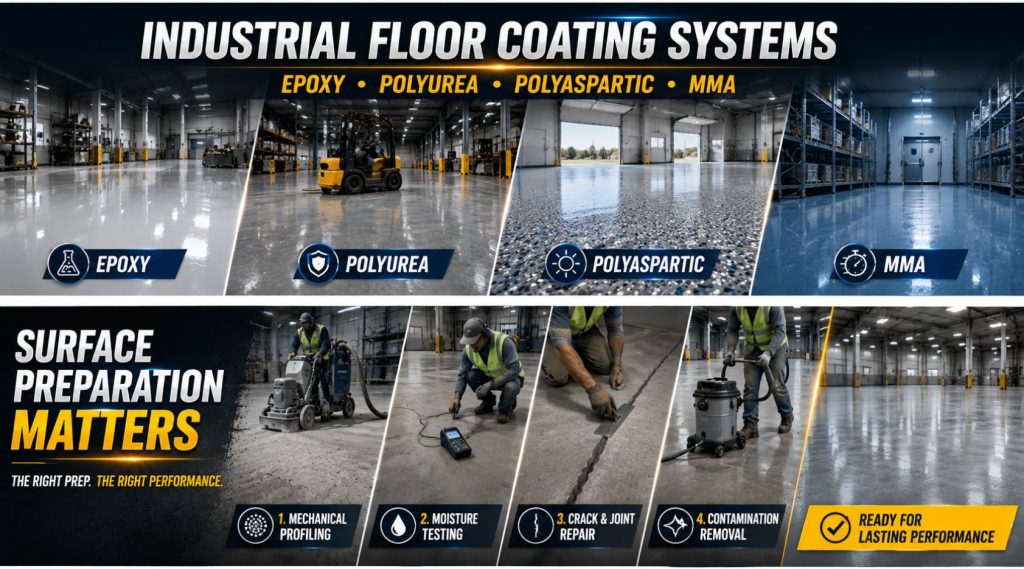
Common Industrial Coating Systems
Epoxy systems remain a widely used baseline option, valued for a lower material cost and a hard, durable finish suited to moderate traffic and typical industrial spills. Epoxy is more rigid than some alternatives, which can be a limitation on floors that see significant substrate movement or thermal cycling.
Polyurea and polyurethane-based systems offer more flexibility and a faster cure than standard epoxy, which matters directly for the downtime question below. These systems tend to hold up well under impact, temperature swings, and heavier abrasion, making them a common choice for facilities that can’t tolerate multi-day shutdowns.
Polyaspartic coatings, often used as a topcoat over a base system, add UV stability and a fast-curing finish layer, which is particularly relevant for facilities with any daylight exposure through bay doors or windows.
MMA (methyl methacrylate) systems cure extremely fast, sometimes within an hour, and can be applied across a wider temperature range than many other systems, which makes them a fit for facilities needing minimal downtime or working in cold storage and refrigerated environments.
No single system is universally correct. The right choice depends on the specific combination of traffic type, chemical exposure, temperature range, and how much time the facility can give up for the work.
What Surface Preparation Actually Requires
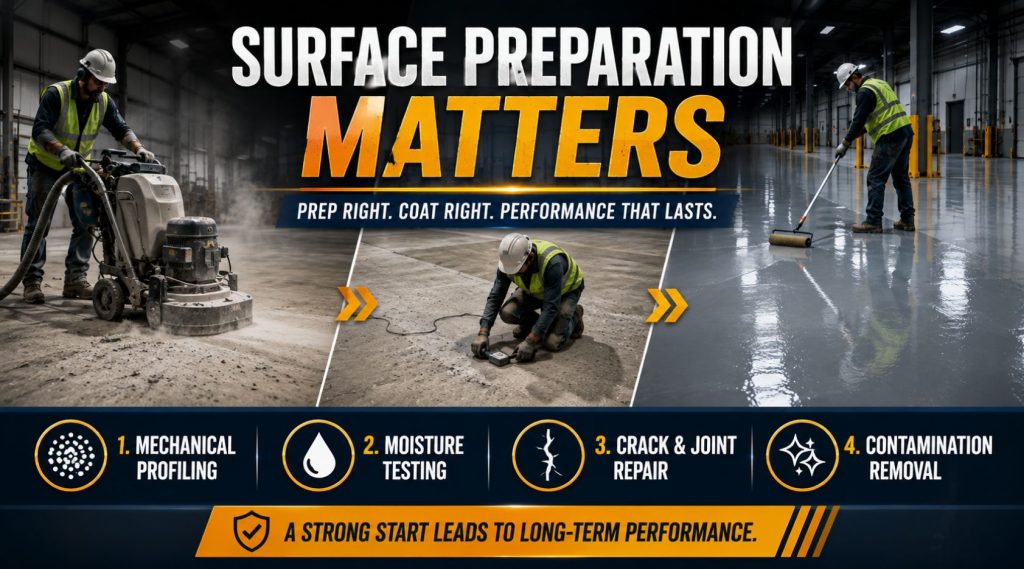
Surface prep is where a large share of coating failures actually originate, and it’s often the step that gets compressed when a project is running behind schedule. Proper preparation typically includes:
- Mechanical profiling, usually through shot blasting, diamond grinding, or scarifying, to create the right surface texture (concrete surface profile, or CSP) for the specific coating being applied. Too smooth a surface and the coating won’t bond properly. Too rough and it can telegraph through thinner coating systems.
- Moisture testing, since excess moisture vapor transmission from below the slab is one of the more common causes of coating failure, particularly blistering and delamination. This is not optional for a slab-on-grade application, and skipping it is one of the more expensive shortcuts a contractor can take.
- Crack and joint repair, addressing any existing cracks or control joints before coating, since coating over unaddressed movement points tends to telegraph the crack back through the new surface over time.
- Contamination removal, including oil, grease, and any existing coating or sealer that needs to be fully removed rather than coated over.
Rushing any of these steps to save a day on the schedule is one of the most common reasons an industrial floor coating fails well before its expected service life, often requiring a full redo that costs more than doing the prep properly the first time would have.
Coating System Comparison
| System | Cure Time | Flexibility | Typical Cost Tier | Best Fit |
|---|---|---|---|---|
| Epoxy | Slower, often 24+ hours between coats | Lower, more rigid | Lower | Moderate traffic, standard industrial use |
| Polyurea / Polyurethane | Fast, often same-day return to service | Higher | Mid to higher | Heavy traffic, temperature swings, minimal downtime needs |
| Polyaspartic (typically as topcoat) | Very fast | Moderate to high | Mid to higher | UV-exposed areas, fast-turnaround projects |
| MMA | Very fast, often within an hour | Moderate | Higher | Cold storage, extreme downtime constraints |
How Coating Choice Affects Downtime
For many facilities, the real cost of a floor coating project isn’t the material or labor line item, it’s the lost production or operational time while the floor is out of service. A slower-curing epoxy system might be the cheapest option on paper, but if it keeps a distribution center offline for three extra days compared to a faster-curing alternative, the total cost picture can flip entirely once lost throughput is factored in.
This is why the “best” system for a given facility often isn’t the one with the lowest material cost or even the longest theoretical service life. It’s the one that balances performance requirements against how much downtime the operation can actually absorb without it becoming the more expensive problem.
Things to Consider Before Choosing a System
- What’s the realistic traffic load and type, forklifts, foot traffic, heavy equipment, that this floor needs to withstand?
- What chemicals or substances does this facility regularly handle that the coating needs to resist?
- How much downtime can operations actually absorb, and does that change the calculus toward a faster-curing system even at a higher material cost?
- Has the substrate been properly tested for moisture and inspected for existing cracks or contamination before a system is chosen?
- Does the contractor doing the work have documented experience with industrial-scale projects specifically, not just smaller residential or light commercial jobs?
For a broader look at how these systems compare across a wider range of applications, our complete guide to polyurea coatings covers the fundamentals in more depth, and our overview of polyurea applications and use cases breaks down specific industry examples beyond flooring.
Maintenance and Long-Term Performance
Once installed, industrial floor coatings generally require routine cleaning appropriate to the facility’s operations and prompt attention to any deep gouges or areas where the coating has been compromised down to bare concrete. Left unaddressed, even a small breach in the coating can allow moisture or chemicals to reach the substrate and undermine adhesion in that area over time.
Facilities with heavy or specialized traffic, industrial casters, chemical drums, repeated impact points, may benefit from periodic professional inspection rather than waiting for visible wear to prompt a look, since catching early coating breakdown is far cheaper than a full recoat once damage has spread.
Frequently Asked Questions
How long does an industrial floor coating typically last?
Service life varies significantly based on the specific system, traffic level, chemical exposure, and how well the substrate was prepared before installation. A well-prepped, appropriately specified system generally outlasts one chosen on cost alone or applied over inadequate prep work.
Is a faster-curing coating always more expensive?
Not necessarily as a flat rule, but faster-curing systems like polyurea, polyaspartic, or MMA often carry a higher material cost than standard epoxy. Whether that premium is worth it usually comes down to how much the facility’s downtime actually costs per day.
Can a coating be applied over an old, failing coating?
Generally not without proper removal and prep first. Coating over a failing existing system tends to fail again quickly, since the new coating is only as good as what it’s bonded to.
Does moisture testing really matter for every project?
Yes, particularly for slab-on-grade applications. Excess moisture vapor from below the slab is one of the leading causes of coating failure, and skipping this test to save time is one of the costlier shortcuts in industrial flooring work.
What’s the biggest factor in whether a coating job succeeds long term?
Surface preparation quality has an outsized impact on outcomes compared to which specific coating product is chosen. A mid-tier system installed over properly prepped concrete typically outperforms a premium system applied over rushed prep work.
Conclusion
Choosing an industrial concrete floor coating system comes down to weighing traffic, chemical exposure, and downtime tolerance against each other, not defaulting to whichever option is cheapest or fastest in isolation. Surface preparation deserves at least as much attention as the coating selection itself, since even the best-suited system will underperform if it’s applied over concrete that wasn’t properly tested, profiled, and repaired first. Getting both pieces right is what separates a floor that holds up for years from one that needs to be redone within a season.