

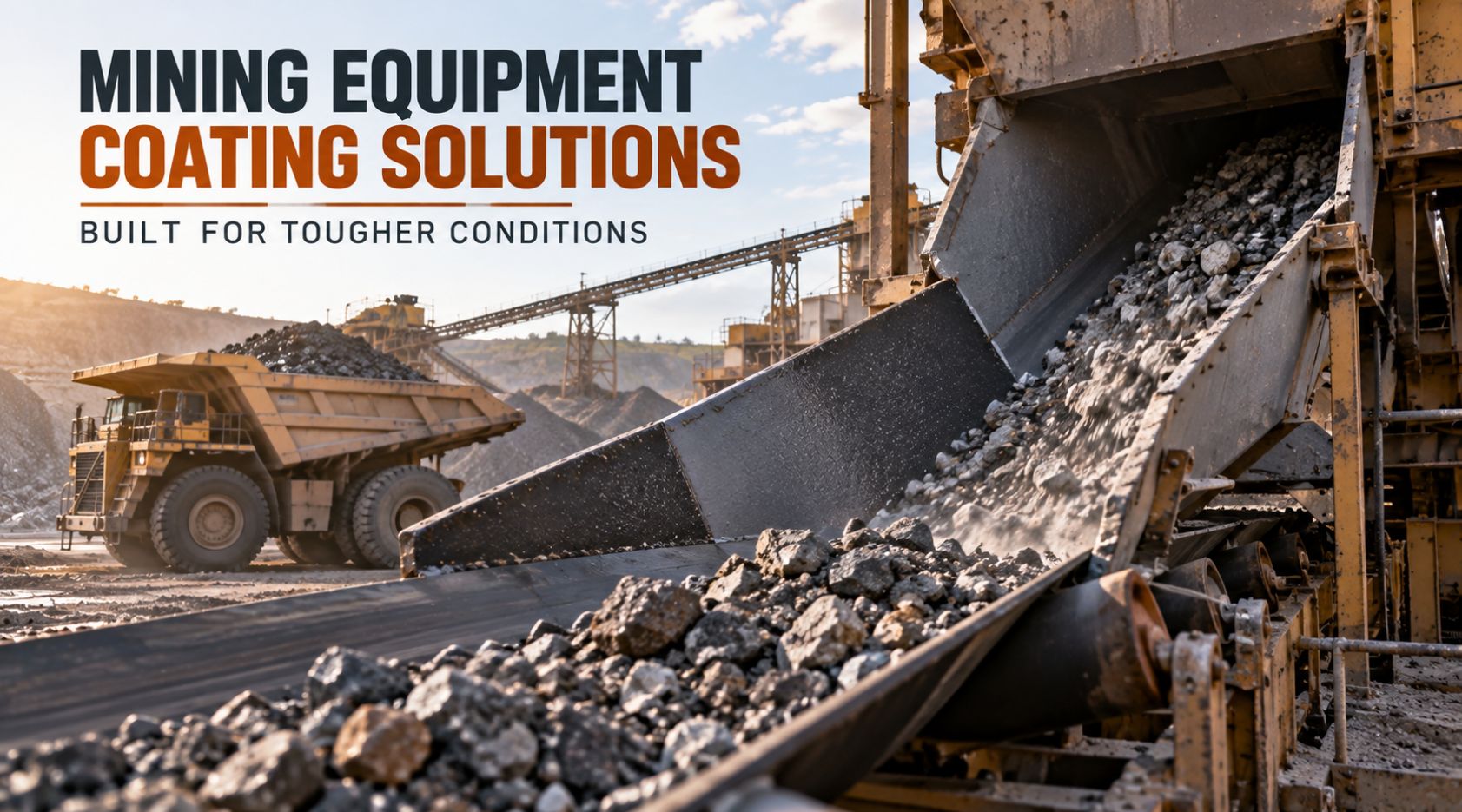
Few industrial environments punish surfaces as aggressively as mining operations. Ore transfer chutes, hoppers, and loading facilities handle thousands of tons of abrasive material daily, vibrating constantly and subjecting every coated surface to impact, abrasion, and chemical attack simultaneously. For decades, wear-resistant steels and rubber liners were the only viable options in these environments. The introduction of ultra-high-abrasion-resistance polyurea formulations has changed the calculus, offering mining operators a coating solution that can outlast rubber in many applications while eliminating the time-consuming installation of mechanical liner systems.
The Physics of Abrasion Resistance in Polyurea
Standard polyurea formulations, while excellent for waterproofing and chemical resistance applications, lack sufficient hardness and toughness for high-abrasion mining environments. Mining-grade polyurea systems are formulated with higher aromatic content, crosslink density modifications, and sometimes hybrid urethane/polyurea chemistry to achieve the specific combination of surface hardness, elastic recovery, and tear resistance that abrasion resistance requires.
The key performance metric for mining applications is abrasion resistance measured by Taber abraser testing (ASTM D4060) or modified dry sand rubber wheel abrasion testing (ASTM G65). Standard polyurea might show Taber abrasion loss of 100-200 mg per 1,000 cycles; mining-grade formulations can achieve 15-40 mg per 1,000 cycles — performance comparable to or better than many hard rubber compounds.
Ore Transfer Chutes and Hoppers
Transfer chutes handling coarse ore, coal, or aggregate are among the highest-impact applications for polyurea in mining. Traditional rubber liners require mechanical attachment, creating a mosaic of panels with seams — the most vulnerable points — and require specialized labor for installation and replacement. Spray-applied polyurea creates a seamless, continuous liner that bonds directly to the steel or concrete substrate, eliminating seams and mechanical attachments.
Thickness specifications for ore chutes typically range from 500 mils (½ inch) to 1,500 mils (1.5 inches) depending on material type, drop heights, and volume. Multiple passes are applied with intermediate cooling periods to prevent heat buildup in the applied coating. Some extreme applications use a hybrid approach: polyurethane foam as a base layer for impact absorption, with a thick polyurea topcoat for abrasion resistance.
Truck Bed Liners for Mining Vehicles
Mining haul trucks are among the largest vehicles on earth, with payload capacities up to 400 tons. The bed surfaces of these trucks are subjected to massive impact from blasted rock drops and continuous sliding abrasion from ore loads. Polyurea spray liners for mining haul trucks are typically applied at 250-500 mils and significantly extend the service life of the steel bed, which would otherwise require expensive weld repair or plating replacement.
The practical advantage for mine operators is reduced downtime: a polyurea liner can typically be recoated over existing liner in 4-8 hours, while steel plating replacement requires 24-72 hours of truck downtime. Over the life of a haul truck (typically 15-20 years in mining operations), the lifecycle cost advantage of polyurea liners over steel plate replacement is substantial.
Slurry Pipeline Linings
Mineral processing operations transport ore slurries through pipelines at high velocity, combining abrasion from solid particles with chemical attack from processing chemicals. Polyurea pipe linings for slurry service require the highest level of abrasion resistance combined with chemical resistance appropriate for the specific minerals and process chemicals present.
Application of polyurea to pipe interiors requires specialized centrifugal spinning equipment or robotic spray heads that can maintain uniform thickness on the pipe wall. This represents a specialized skill set within the broader polyurea industry. Learn about advanced application techniques in our education and training programs.
Surface Preparation Challenges in Mining Environments
Surface preparation for mining applications presents unique challenges. Steel in mining facilities is frequently contaminated with lubricants, mineral deposits, and corrosion products that are difficult to remove completely. High-pressure water jetting combined with abrasive blasting is the standard preparation sequence. The tight application schedule required after blasting (to prevent flash rusting) means careful project management and sometimes the use of zinc-rich primer on steel surfaces where the window to apply polyurea is constrained.
Case Study: Open-Pit Copper Mine, New Mexico
American Polyurea member company Southwest Industrial Coatings completed a major mining application project in 2025 at an open-pit copper mine in New Mexico. The project involved lining 14 ore transfer chutes, 6 feed hoppers, and 3 primary crusher feed areas — totaling approximately 45,000 square feet of spray-applied mining-grade polyurea at an average thickness of 750 mils.
The previous liner system (rubber sheet bonded with contact adhesive) had required annual replacement on the highest-wear chutes. Following the polyurea application, the mine operator measured virtually no wear after 12 months of production — the project’s primary objective. The polyurea liner on the highest-volume chute was 18 months into service at the time of this writing with no significant wear observed. The mine operator estimates this will translate to a $1.2 million reduction in annual maintenance costs if performance continues.
Entering the Mining Market as a Polyurea Applicator
The mining sector represents a high-value, high-specification market for polyurea applicators. Entry requirements include mining safety certifications (typically MSHA Part 48 underground or surface miner training), experience with confined space work, and demonstrated expertise with high-build, multi-pass applications. Developing relationships with mine maintenance engineers and working as a subcontractor to established industrial coatings companies is a common pathway into this market.
Connect with polyurea professionals experienced in mining applications through the American Polyurea member community. Our Find a Certified Applicator directory can also connect mining operators with qualified polyurea contractors in their region.
Get polyurea news in your inbox
New articles, application guides and industry news from American Polyurea. Unsubscribe anytime.
We’ve had our mining-grade polyurea system on an ore transfer chute for 26 months now at a quarry operation in southern Indiana. The wearing rate appears to be about 40 mils per year on the highest impact areas. We originally applied 750 mils, so we’re looking at roughly 10+ years before we need to recoat — vs. the 8-12 month rubber liner replacement cycle they were on before.