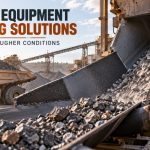

Ore doesn’t care what it’s sliding across. Chutes, hoppers, and truck beds all take the same relentless abuse from rock, ore, and aggregate moving through a mining operation at high volume, and the wear shows up fast. Mining equipment coating abrasion protection has become standard practice at most operations for exactly this reason: the cost of unplanned downtime to repair a worn-through chute or a punctured truck bed liner almost always outweighs the cost of protecting that surface properly in the first place. The question isn’t really whether to protect these surfaces. It’s which protection method actually holds up to the specific combination of impact and sliding wear a given piece of equipment sees.
Where the Wear Actually Happens
Three areas tend to fail faster than the rest of a mining operation’s material handling equipment, and each wears differently.
Transfer chutes take a brutal combination of impact and sliding abrasion. Material drops from height, strikes the chute surface, and then slides across it on its way to the next stage of the process. The impact point wears differently than the sliding zone further down the chute, which is part of why a one-size-fits-all wear solution often underperforms compared to something tailored to how material actually moves through a specific chute geometry.
Hoppers see similar loading impact at the point where material first enters, along with sliding wear as material works its way toward the discharge opening. Bridging and buildup at the discharge can make wear worse in that specific area, since material that isn’t flowing properly tends to grind rather than slide cleanly.
Truck beds face their own version of this problem. Blasted rock and ore drop into the bed from significant height, and the impact alone causes real wear over thousands of load cycles. There’s also a second problem that isn’t really about wear at all: material sticking to the bed, known as carryback, which reduces effective payload and creates its own maintenance headache when it has to be knocked loose before the next load.
Why Mining Equipment Coating Abrasion Resistance Matters for Uptime
The financial case for protecting these surfaces properly comes down almost entirely to downtime. A chute that wears through mid-shift means an unplanned stoppage to patch or replace it, and depending on where that chute sits in the process, it can shut down a much larger section of the operation than just the one component. The same logic applies to a truck bed liner that fails: a truck out of rotation for a bed repair isn’t hauling material, and haul truck capacity is usually one of the tighter constraints in the whole operation.
Beyond avoiding failure, there’s a real efficiency angle too. A truck bed that resists material sticking cuts down on the time and labor spent knocking carryback loose, and it can improve effective payload by reducing the dead weight of stuck material riding along on every haul. None of that shows up as dramatically as a catastrophic failure, but across a fleet running continuously, it adds up.
Comparing Wear Protection Options
| Factor | Bare Steel | AR Steel Plate | Ceramic Tile | Spray-Applied Polyurea/Polyurethane Lining |
|---|---|---|---|---|
| Abrasion resistance | Low | Good | Very good against sliding wear | Good, varies by formulation and thickness |
| Impact resistance | Low, deforms and wears | Good | Prone to cracking under high impact | Good, flexible film absorbs impact well |
| Added weight | None | Significant | Moderate to significant | Generally light relative to steel and ceramic |
| Repairability | Not applicable | Requires cutting and welding | Individual tile replacement, labor intensive | Can often be patched or recoated in place |
| Reduces material sticking | No | No | No, can be worse due to surface texture | Often improves release properties depending on formulation |
| Install time | Not applicable | Longer, welding required | Longer, tile-by-tile installation | Generally faster, especially for repairs |
None of these options is universally correct. AR steel plate has a long track record and handles high-impact zones well, but it adds significant weight, which matters on mobile equipment like haul trucks where payload capacity is directly tied to revenue. Ceramic tile offers excellent resistance to pure sliding wear but can crack under sharp impact, making it a poor fit for the impact zones directly under a loading point even when it performs well further down a chute where material has slowed and is mostly sliding. Spray-applied polymer linings, whether polyurea or polyurethane based depending on the specific application, offer a flexible middle ground: good abrasion resistance, strong impact tolerance because the film flexes rather than cracks, and a weight profile that doesn’t eat into payload the way steel plate does.
Matching the Lining to the Wear Zone
A well-designed wear protection plan often uses more than one material across a single piece of equipment, matched to how wear actually varies across that surface.
High-impact loading zones, where material first strikes a chute or hopper surface, benefit from either heavy AR steel plate or a thicker spray-applied polymer lining specifically formulated for impact resistance, since these areas need to absorb repeated direct impact without cracking or deforming.
Sliding wear zones, further along a chute or toward a hopper’s discharge, can often use a thinner lining system since the wear mechanism there is more about sustained sliding contact than repeated impact. This is frequently where ceramic tile performs best when impact isn’t a major factor in that specific zone.
Truck bed interiors benefit from a spray-applied lining specifically for the combination of impact resistance and improved material release, addressing both the wear problem and the carryback problem in a single application rather than treating them as separate issues. Our complete guide to polyurea coatings covers the underlying chemistry that gives these formulations their flexibility and abrasion resistance, which is useful background for understanding why a spray-applied system behaves so differently from a rigid liner material under the same impact conditions.
For a broader look at how these same coating principles apply across different industrial linings beyond mining specifically, our applications and use cases page and our piece on polyurea for manhole and sewer linings both cover related lining applications where the same core logic, protecting a surface from a combination of mechanical and chemical exposure, shows up in a different context.
Things to Consider Before Choosing a Lining System
Assess the actual wear mechanism at each specific location, not the equipment as a whole. A single chute can have distinct impact and sliding wear zones that genuinely benefit from different protection strategies, and treating the whole surface identically often means overspending in low-wear areas while underprotecting the worst ones.
Factor in weight if the equipment is mobile. Haul truck bed liners in particular need to weigh the abrasion resistance benefit against the payload cost of a heavier lining system, since every pound of liner is a pound of ore or rock the truck isn’t hauling.
Plan for realistic reline intervals based on tonnage, not the calendar. Wear accumulates based on material volume and abrasiveness, not time, so a lining schedule tied to actual throughput tends to catch problems before failure far more reliably than a fixed annual schedule applied across equipment with very different usage rates.
Consider repair speed as part of the total cost equation. A lining system that can be patched in place during a shorter maintenance window has a real operational advantage over one that requires removing and replacing large sections, even if the base material cost is similar.
Confirm the specific product’s abrasion and impact ratings from the manufacturer’s technical documentation. Performance varies meaningfully between formulations even within the same general coating category, and a system suited to one wear profile isn’t automatically the right choice for a different zone with different mechanical demands.
Maintenance and Wear Monitoring
Ongoing thickness monitoring, whether through periodic ultrasonic gauging or scheduled visual inspection at known wear points, gives an operation the ability to plan reline work before a failure rather than reacting to one. Tracking wear rates by location over time also builds a useful record for refining which lining material makes sense where, since actual field performance data from an operation’s own equipment is more valuable than a general industry assumption about what should work.
Scheduled inspection timed to coincide with other planned maintenance, rather than as a separate standalone event, tends to get done more consistently, since it doesn’t require pulling equipment out of rotation solely for a lining check.
Hybrid Approaches Worth Considering
A lot of operations eventually land on a hybrid strategy rather than committing to a single wear material across the board, and there’s good reason for that. A composite system, steel plate as the structural base with a spray-applied polymer coating over top, can combine the raw impact strength of steel with the abrasion resistance and easier repairability of a polymer surface layer. This kind of approach shows up often in high-throughput transfer points where the cost of getting the wear solution wrong, in either direction, is high enough to justify a more engineered solution rather than a single off-the-shelf material choice.
The tradeoff with any hybrid system is added complexity in both specification and repair. A composite lining needs clear documentation on how it was built and how it should be repaired when it eventually wears through, since a repair crew unfamiliar with the original system’s construction can easily apply an incompatible patch material that fails faster than the surrounding original lining. Keeping accurate as-built records for any hybrid lining system pays off considerably the first time it needs field repair rather than full replacement.
Frequently Asked Questions
How long does a spray-applied wear lining typically last in mining applications?
This depends heavily on the specific material handled, throughput volume, and the exact formulation and film thickness applied. The manufacturer’s technical data sheet and an operation’s own tracked wear history are the most reliable sources for expected service life in a specific application.
Can a spray-applied lining be used alongside AR steel plate on the same piece of equipment?
Yes, and this is a common approach. High-impact zones might use steel plate or a thick impact-resistant polymer lining, while adjacent sliding wear zones use a different thickness or material better suited to that specific wear pattern.
Does a lining actually reduce material carryback on truck beds?
Many spray-applied lining systems do improve material release compared to bare steel, though the degree varies by formulation and the specific material being hauled. This should be confirmed against the specific product’s documented performance rather than assumed as a universal benefit of the category.
Is ceramic tile ever a better choice than a spray-applied lining?
In pure sliding wear zones without significant impact exposure, ceramic tile can offer excellent wear life. It becomes a weaker choice in zones with direct impact, where its tendency to crack under sharp loading is a real limitation.
How often should chute and hopper linings be inspected?
Inspection frequency should be based on tonnage throughput and material abrasiveness rather than a fixed calendar interval, since wear accumulates with volume handled, not time elapsed.
Conclusion
Mining equipment coating abrasion protection isn’t a single product decision so much as a matching exercise: identifying where impact wear dominates, where sliding wear dominates, and where weight or repairability constraints rule certain materials out entirely. Spray-applied polymer linings have earned a real place in that toolkit because they handle impact without cracking, add less weight than steel plate, and can often be repaired faster than tile-based systems. Getting the most out of any of these options still comes down to matching the specific lining to the specific wear zone, rather than applying one solution across an entire piece of equipment regardless of how differently each section actually wears.