Most people who walk past a government building, a military facility, or a critical infrastructure site have no idea the interior walls might be doing something a lot more sophisticated than holding up the roof. A blast mitigation coating applied to a masonry wall changes how that wall fails under blast pressure, from a hazard that sends concrete block fragments flying like shrapnel into one that holds together and deforms instead, buying occupants a genuinely different outcome in a worst-case event.
This guide covers what a blast mitigation coating actually does mechanically, which substrates and wall types it gets specified for, and how performance in this category gets tested and standardized across the industry, information worth understanding whether you’re a facility manager evaluating a retrofit or simply curious about the engineering hiding behind an ordinary-looking interior wall.
Why Masonry Walls Need This Kind of Protection
Concrete masonry unit walls, the standard CMU block construction common in government, military, and many commercial buildings, have a failure mode that’s genuinely dangerous under blast loading. Unreinforced or lightly reinforced masonry is brittle, and when it fails under sudden pressure, it doesn’t bend or deform gracefully, it shatters into fragments that get propelled at high velocity by the blast wave itself. In documented incidents and testing, this fragmentation, not the blast pressure alone, has been identified as a leading cause of injury to building occupants, sometimes at a greater distance from the actual event than the pressure wave itself would suggest is dangerous.
This is the specific problem a blast mitigation coating is designed to solve. It doesn’t necessarily prevent the wall from failing under a large enough blast load, but it fundamentally changes what that failure looks like and how dangerous the resulting debris is to anyone inside the structure.
How a Blast Mitigation Coating Actually Works
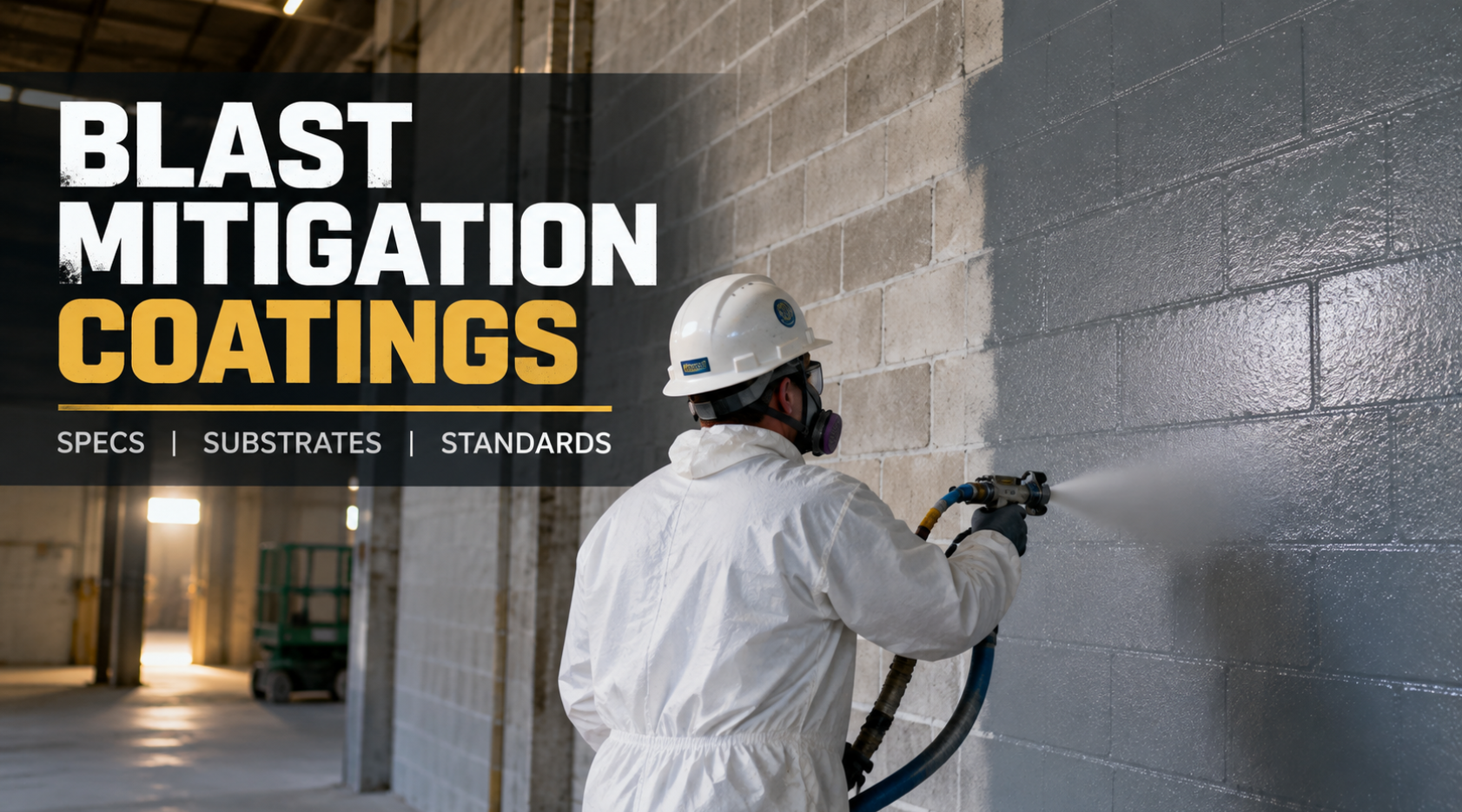
The mechanism is more about elastomeric behavior than raw strength. A polyurea-based blast mitigation coating is applied as a continuous, flexible membrane across the interior wall surface, bonding directly to the masonry substrate. When the wall is subjected to blast pressure severe enough to crack or fracture the masonry itself, the coating’s elasticity allows it to stretch and deform along with the failing wall rather than tearing or shattering alongside it.
That elongation is what actually retains the fragments. Instead of individual masonry blocks and fragments becoming separate, high-velocity projectiles, the coating holds the fractured material together as a single, deforming mass, dramatically reducing the debris field and the resulting injury risk to anyone on the protected side of the wall. This fragmentation retention function is really the entire point of the coating, distinct from a coating’s more familiar roles in abrasion or chemical resistance covered elsewhere in general polyurea applications.
Substrates and Wall Types Where This Gets Specified
CMU block walls are the most common substrate for blast mitigation coating specification, given how widely this construction type is used in exactly the facility categories, government buildings, military installations, embassies, that most commonly carry blast resistance requirements in the first place. Poured concrete walls and tilt-up concrete panels also receive this kind of protective treatment, particularly in retrofit projects on older structures that weren’t originally designed with blast resistance in mind and are now being upgraded to meet current security expectations.
It’s worth noting that window and glazing systems represent a separate, related but distinct category of blast protection, typically addressed through laminated or film-treated glazing systems and specialized framing rather than a spray-applied wall coating, since the failure mode and protection mechanism for glass differs substantially from masonry. A comprehensive blast mitigation retrofit project typically addresses walls and glazing as separate but coordinated scopes of work rather than treating one as a substitute for the other.
Specification Factors That Actually Matter
Coating thickness for blast mitigation applications is specified based on the wall’s construction, the facility’s threat level classification, and the specific performance criteria the project needs to meet, and this is meaningfully different from thickness specifications for a typical protective or decorative polyurea application used on a floor or tank. Higher threat classifications generally call for thicker, higher-performance coating systems, and getting this specification right requires engineering input specific to the project rather than a generic thickness assumption carried over from an unrelated application.
Application coverage matters just as much as thickness. Retrofit blast mitigation projects typically coat the interior face of the wall, the side facing building occupants, since the goal is protecting people inside the structure from fragmentation rather than addressing the exterior blast event itself. Anchor and edge treatment details, how the coating terminates at floor, ceiling, and wall intersections, and how it’s detailed around openings, are frequently where a project’s actual performance diverges from its theoretical design, since a coating that performs beautifully on a flat wall section can still fail to deliver the intended protection if the edges and transitions weren’t properly detailed and executed.
Testing and Standards in This Category
Performance in this category is evaluated through standardized testing protocols developed by recognized authorities in blast-resistant design, including criteria established by the General Services Administration and Department of Defense antiterrorism and force protection standards, along with relevant ASTM test methods developed specifically for blast-resistant building components. These frameworks define threat level classifications and performance criteria that a coating system needs to meet or exceed for a given application, and compliance is typically demonstrated through documented testing by an accredited facility rather than taken on a manufacturer’s claim alone.
Given the specialized and safety-critical nature of this application category, project-specific engineering consultation and verification against current applicable standards for the specific facility type and threat classification is essential, rather than relying on general product marketing claims. Our polyurea industry glossary covers some of the technical terminology that comes up in this specialized area, useful background before getting into a detailed project specification conversation with an engineer or contractor.
How This Differs From General Protective Coating Specification
Readers familiar with polyurea from more common applications, tank linings, secondary containment, industrial flooring, should understand that blast mitigation represents a genuinely specialized subset of the broader polyurea coating category, with its own performance criteria, testing requirements, and application standards that don’t directly carry over from general protective coating use. Our complete guide to polyurea coating covers the underlying chemistry that makes elastomeric behavior possible across polyurea’s applications broadly, which is the same fundamental property that makes blast mitigation performance achievable, just applied toward a very different performance goal than abrasion or chemical resistance.
Blast Mitigation Coating at a Glance
| Factor | What It Involves |
|---|---|
| Primary substrate | CMU masonry block walls, also poured concrete and tilt-up panels |
| Application side | Typically interior face, protecting building occupants |
| Core mechanism | Elastomeric fragmentation retention, not blast pressure prevention |
| Thickness specification | Determined by wall construction and facility threat classification |
| Critical detail areas | Edge terminations, anchor points, wall-to-floor/ceiling transitions |
| Testing framework | GSA, DoD/UFC antiterrorism criteria, relevant ASTM test methods |
Things to Consider Before Specifying a Blast Mitigation Project
- Has the facility’s threat level classification been established through proper engineering assessment, rather than assumed based on general facility type?
- Does the specified coating thickness and system actually meet documented performance criteria for that specific threat classification, verified through accredited testing?
- Are window and glazing systems being addressed as a coordinated but separate scope alongside wall coating, rather than assuming wall protection alone is sufficient?
- Has edge and transition detailing received the same engineering attention as the flat wall field, since this is frequently where real-world performance diverges from design intent?
- Is the contractor performing the work experienced specifically with blast mitigation applications, given how different the specification and quality requirements are from general protective coating work?
For facilities weighing the investment involved in a project like this against a broader protective coating budget, our guide on what drives polyurea coating cost per square foot covers general cost factors, though blast mitigation projects carry additional engineering, testing documentation, and specification requirements that add cost beyond a standard protective coating application. Our broader overview of polyurea applications also places this specialized use case within the full range of situations polyurea coatings address.
Frequently Asked Questions
Does a blast mitigation coating prevent a wall from being damaged in a blast event?
Not necessarily. Its primary function is fragmentation retention, changing how a wall fails rather than necessarily preventing failure altogether, which significantly reduces the injury risk from flying debris even when the underlying wall structure is compromised.
Can any polyurea coating provide blast mitigation performance?
No. Blast mitigation is a specialized application with specific thickness, substrate preparation, and detailing requirements verified through accredited testing, distinct from general-purpose protective or decorative polyurea coatings.
Is blast mitigation coating only used on government and military buildings?
These facility types are the most common application given regulatory and threat assessment requirements, but critical infrastructure and certain high-risk commercial facilities can also specify this kind of protection based on their own risk assessment.
Does window glazing need separate blast protection from wall coating?
Yes. Glazing systems typically use laminated or film-based blast protection approaches distinct from wall coating, and a complete blast mitigation strategy generally addresses both as coordinated but separate scopes.
How is blast mitigation coating performance actually verified?
Through documented testing against recognized standards, including GSA and DoD/UFC antiterrorism criteria and relevant ASTM test methods, rather than relying solely on manufacturer performance claims without independent verification.
Conclusion
Blast mitigation coating is one of the more specialized applications in the broader polyurea category, built on the same elastomeric chemistry that gives polyurea its flexibility in more common uses, but applied toward a very specific and safety-critical goal: keeping masonry fragmentation from becoming a secondary hazard when a wall fails under blast loading. Getting a project like this right depends on proper threat classification, verified performance testing, and careful attention to detailing at edges and transitions, not just choosing a coating and applying it at a standard thickness the way a more routine protective application might be handled. Treating this as a specialized engineering project rather than a standard coating job is ultimately what separates a system that performs as intended from one that only looks the part on paper.
Get polyurea news in your inbox
New articles, application guides and industry news from American Polyurea. Unsubscribe anytime.