Metal roof panels themselves are tough. They shrug off hail, shed water, and last for decades without much drama. The leaks that actually show up almost always trace back to somewhere else entirely: a lap seam where two panels overlap, or one of the thousands of exposed screw fasteners holding the whole system together. A polyurea roof coating metal building owners choose for a restoration project earns that reputation specifically because it addresses those weak points directly, rather than treating the broad, already-durable panel field as the thing that needs the most attention.
Why a Polyurea Roof Coating Metal Building System Targets Seams and Fasteners First
Every exposed fastener on a metal roof is a potential leak path. The rubber or neoprene washer under each screw head degrades over years of UV exposure and thermal cycling, and as the metal panels expand and contract through daily and seasonal temperature swings, the screw holes themselves gradually elongate, a problem commonly called fastener backout. Once a washer has hardened and cracked, or a hole has worked itself slightly oversized, water finds its way in during the next hard rain, and it doesn’t always show up as an obvious drip directly below that fastener. It can travel along a purlin or follow a seam before finally appearing somewhere else inside the building entirely, which is part of why diagnosing a metal roof leak by sight alone is so often a frustrating exercise.
Lap seams have their own version of the same problem. Sealant applied between overlapping panels during original construction dries out and cracks under years of UV exposure and the constant minor movement of the panels themselves. A seam that was watertight on installation day can develop a hairline gap a decade later, invisible from the ground and easy to miss during a casual walk across the roof.
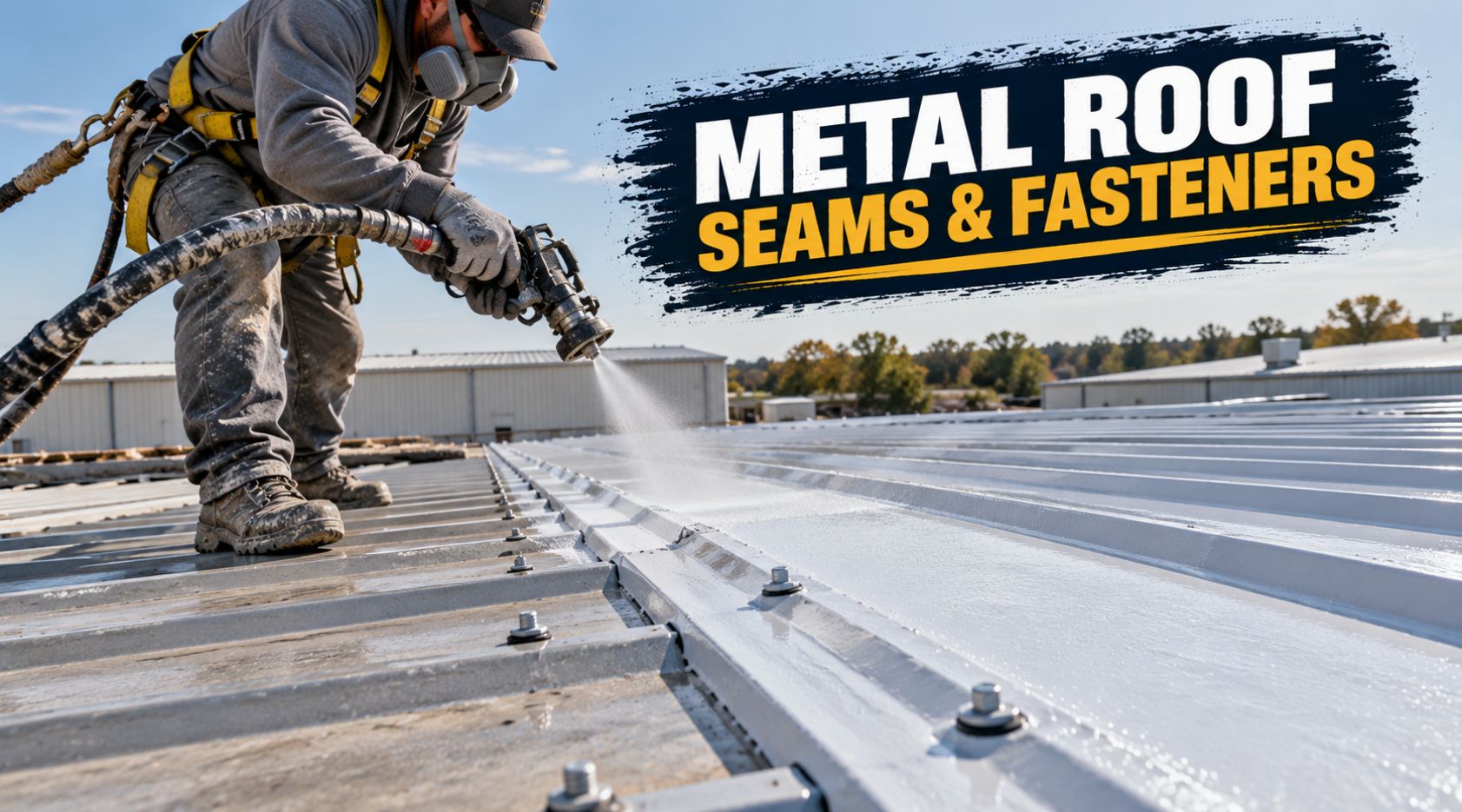
A properly applied polyurea or polyurethane roof coating system addresses both problems at once by forming a continuous, seamless membrane across the entire roof surface, encapsulating every fastener and seam under one monolithic layer rather than leaving thousands of individual failure points to be inspected and patched one at a time. Because the cured film stays flexible, it moves with the roof’s normal thermal expansion and contraction instead of cracking the way a rigid sealant or an aged, brittle washer eventually does.
How a Roof Coating Project Actually Addresses These Problem Areas
A legitimate roof restoration project doesn’t just spray a uniform coat over everything and call it done. It starts with inspection, walking the roof to identify failed or backed-out fasteners, deteriorated seam sealant, and any areas already showing active rust or panel damage. Fasteners that have failed structurally, not just cosmetically, generally need to be replaced before coating, not simply coated over, since a coating can waterproof a fastener but it can’t restore one that’s lost its structural grip in the panel.
Seams and penetrations, pipe boots, HVAC curbs, skylights, and anywhere the roof plane changes direction, typically get reinforced with a fabric or scrim embedded into the coating at those specific locations. This reinforcement adds tensile strength exactly where the roof sees the most movement and stress, rather than relying on the coating’s base film thickness alone to bridge a gap that’s likely to keep moving over time. Only after this detail work is complete does the full field membrane go down across the broader panel areas, followed by a UV-stable topcoat where the system calls for one.
Comparing Restoration Approaches
| Approach | Addresses Fasteners and Seams | Disruption to Operations | Typical Cost | Lifespan Extension |
|---|---|---|---|---|
| Spot sealant touch-up | Partially, only where applied | Minimal | Low | Short-term, often needs repeating |
| Full roof tear-off and replacement | Fully, new system entirely | Significant, extended downtime | High | Longest, resets roof life fully |
| Spray-applied polyurea/polyurethane coating system | Fully, seamless membrane over all fasteners and seams | Low, roof generally stays in service during application | Moderate | Substantial, extends service life without full replacement |
Why This Matters for Metal Building Owners Specifically
Metal buildings used for warehousing, agricultural storage, light industrial, or commercial purposes often can’t tolerate the kind of extended downtime a full tear-off and replacement demands. A coating-based restoration generally allows the building to stay operational throughout most of the project, since work can often proceed in sections without requiring the roof to be fully opened up the way a tear-off does. That’s a meaningful practical advantage for an owner weighing the cost of restoration against the cost of a full roof replacement, separate from the coating’s direct waterproofing performance.
Cost comparison matters here too. A properly executed coating restoration typically costs meaningfully less than full replacement while still addressing the root causes of most metal roof leaks, provided the underlying seams and fasteners actually get the reinforcement and repair they need rather than being coated over as-is. For broader background on how polyurea’s chemistry delivers the flexibility and adhesion that make this kind of application work, our complete guide to polyurea coatings covers the underlying reaction and its resulting properties in more depth. Our applications and use cases page also covers where this same coating technology shows up across different project types beyond roofing specifically, which is useful context for understanding why the same core chemistry performs so differently depending on the application it’s engineered for.
Things to Consider Before Coating a Metal Roof
Address active leaks and trapped moisture before coating, not after. A coating seals the exterior surface, but if water has already gotten into the building’s insulation or structural assembly through a long-standing leak, that moisture needs to be dealt with separately. Coating over a roof with unresolved trapped moisture underneath doesn’t solve the underlying problem, it just makes it harder to see.
Get an honest assessment of panel condition, not just surface condition. Coating restoration works well on panels that are structurally sound with surface-level wear, rust spots, and failing seams. Panels with advanced corrosion or structural compromise may need localized panel repair or replacement before a coating system can do its job properly, and no coating is a substitute for addressing a panel that’s genuinely failed structurally.
Confirm fastener replacement is part of the scope, not just coating over existing hardware. A coating can waterproof a sound fastener, but it can’t restore structural holding power to one that’s already stripped or backed out. This detail work should be explicitly part of the project scope, not assumed to be covered by the coating application itself.
Ask specifically about seam and penetration reinforcement. A coating applied at uniform thickness across the whole roof without extra reinforcement at seams, fasteners, and penetrations is relying on the base film alone to handle the areas that see the most movement and stress. Confirm that reinforcing fabric or scrim is part of the specified system at these detail areas.
Check roof slope and drainage before assuming a coating alone will solve a ponding water problem. A coating improves waterproofing, but it doesn’t correct inadequate drainage or roof pitch. Standing water sitting on a coated roof for extended periods still stresses the system over time, regardless of how well the coating itself performs.
Timing the Project Right
Metal building owners often ask when to actually schedule a roof restoration, and the honest answer is sooner than most people get around to it. Waiting until a leak is actively dripping inside the building usually means water has already found its way past the exterior surface and into the insulation or structural assembly below, turning what could have been a straightforward exterior coating project into one that also requires interior remediation first. Catching fastener backout and seam deterioration during a proactive inspection, before any interior leak symptoms show up, keeps the project scope limited to what it should be: exterior waterproofing and reinforcement, not interior repair on top of it.
Weather conditions during application matter too. Most coating systems have a specified temperature and humidity range for proper cure, and scheduling the work during a season or stretch of weather that reliably falls within that range reduces the risk of application problems that can compromise the finished system. For buildings in climates with a narrow weather window, planning the project well ahead of the season it needs to happen in, rather than reacting to a leak in the middle of an inconvenient stretch of weather, tends to produce a better outcome and more scheduling flexibility for both the contractor and the building’s normal operations.
Coverage and Planning
Coverage for a spray-applied roof coating system follows the same basic math used across the industry: one gallon spread at one mil thickness covers 1,604 square feet. Actual material requirements depend on the specified dry film thickness for the roof system in question, which should come from the manufacturer’s technical data sheet based on the roof’s condition, exposure, and expected service life, rather than a generic assumption carried over from a different type of project.
Maintenance After Coating
A coated metal roof still benefits from periodic inspection, ideally at least annually and after any major weather event, checking specifically for any new mechanical damage, debris accumulation that could trap moisture against the surface, and general wear at high-traffic areas like rooftop equipment access points. Most coating systems come with a documented service life and, in many cases, a warranty tied to proper installation and maintenance, so keeping basic inspection records supports both the practical goal of catching problems early and the administrative goal of maintaining any applicable warranty coverage.
Frequently Asked Questions
Can a polyurea roof coating be applied without replacing any fasteners?
It can, but any fasteners that have already failed structurally, backed out, stripped, or lost their grip in the panel, should be replaced first. Coating over a structurally failed fastener waterproofs the surface without restoring the holding power that fastener was supposed to provide.
How long does a coated metal roof typically last before needing attention again?
This depends on the specific coating system, film thickness, and the roof’s exposure conditions. The manufacturer’s technical documentation for the specific product gives the expected service life, and periodic inspection should guide any touch-up needs before a full recoat becomes necessary.
Does coating a metal roof stop condensation problems inside the building?
Not directly. A roof coating addresses exterior waterproofing, but interior condensation is generally a separate issue related to building insulation, ventilation, and humidity control, which needs its own evaluation if it’s a concern.
Is a roof coating a permanent fix, or will the roof eventually need full replacement anyway?
A properly applied coating significantly extends a metal roof’s service life, but it’s a restoration strategy, not an indefinite guarantee. Eventually, any roof system reaches the end of its practical service life, though a well-executed coating restoration can push that timeline out substantially compared to doing nothing.
Can a metal building stay in operation during a roof coating project?
In most cases, yes. Coating application generally allows the building to remain operational throughout most of the project, which is one of the practical advantages over a full tear-off and replacement that typically requires more extensive roof access and downtime.
Conclusion
A metal building roof rarely fails because the panels themselves gave out. It fails at the seams and fasteners, the thousands of small detail points where water actually finds a way in. A polyurea roof coating metal building system built around proper inspection, fastener repair where needed, and real reinforcement at seams and penetrations addresses those failure points directly, extending the roof’s service life without the cost and disruption of a full replacement. Getting that detail work right, not just applying a uniform coat across the field, is what separates a restoration that actually solves the leak problem from one that just delays it.
Get polyurea news in your inbox
New articles, application guides and industry news from American Polyurea. Unsubscribe anytime.